Skip to main content
Analytical Chemistry
My Course
Learn
Exam Prep
AI Tutor
Study Guides
Flashcards
Explore
Try the app
My Course
Learn
Exam Prep
AI Tutor
Study Guides
Flashcards
Explore
Try the app
Back
Strong Acid-Strong Base Titrations quiz
You can tap to flip the card.
Why are ICF charts used instead of ICE charts for strong acid-strong base titrations?
You can tap to flip the card.
👆
Why are ICF charts used instead of ICE charts for strong acid-strong base titrations?
ICF charts are used because strong acids and bases dissociate completely, so calculations are based on moles rather than equilibrium concentrations.
Track progress
Control buttons has been changed to "navigation" mode.
1/15
Related flashcards
Related practice
Recommended videos
Strong Acid-Strong Base Titrations quiz #1
Strong Acid-Strong Base Titrations
10 Terms
Strong Acid-Strong Base Titrations definitions
Strong Acid-Strong Base Titrations
15 Terms
Strong Acid-Strong Base Titrations
10. Acid-Base Titrations
5 problems
Topic
Weak Acid-Strong Base Titrations
10. Acid-Base Titrations
5 problems
Topic
10. Acid-Base Titrations - Part 1 of 2
4 topics
12 problems
Chapter
10. Acid-Base Titrations - Part 2 of 2
1 topic
3 problems
Chapter
Guided course
05:47
Strong Base-Strong Acid Titration
486
views
6
rank
2
comments
Guided course
02:55
Strong Acid-Strong Base Titration
368
views
1
rank
Guided course
03:18
Strong Base-Strong Acid Calculations Practice
430
views
3
rank
Terms in this set (15)
Hide definitions
Why are ICF charts used instead of ICE charts for strong acid-strong base titrations?
ICF charts are used because strong acids and bases dissociate completely, so calculations are based on moles rather than equilibrium concentrations.
What does the equivalence point represent in a strong acid-strong base titration?
The equivalence point is where the moles of acid equal the moles of base, resulting in complete neutralization.
How do you calculate the equivalence volume in a titration?
Use the formula: molarity of acid × volume of acid = molarity of base × volume of base.
What is the pH at the equivalence point of a strong acid-strong base titration at 25°C?
The pH is 7, indicating a neutral solution.
How do you determine pH before the equivalence point when titrating a strong base with a strong acid?
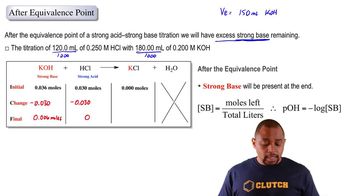
Calculate the concentration of the excess strong base, find its pOH, and then use pH = 14 - pOH.
What happens to pH after the equivalence point in a strong acid-strong base titration?
The pH is determined by the excess strong acid or base present, resulting in a low pH for excess acid or high pH for excess base.
How is the concentration of ions calculated for strong acids and bases?
The concentration of the acid or base equals the concentration of its dissociated ions because they dissociate 100%.
What is the formula for calculating pH from the concentration of H+ ions?
pH = -log[H+].
What is the formula for calculating pOH from the concentration of OH- ions?
pOH = -log[OH-].
How do you find the concentration of a reactant after titration but before the equivalence point?
Divide the moles of the reactant left by the total volume of the solution.
What is the role of the neutral salt formed at the equivalence point in pH calculations?
If activity coefficients are ignored, the neutral salt does not affect the pH.
What is the limiting reactant in a strong acid-strong base titration before the equivalence point?
The reactant with the smaller number of moles is the limiting reactant and is completely consumed.
How does the pH change as you add strong base to a strong acid before reaching the equivalence point?
The pH gradually increases as the strong base neutralizes the strong acid.
What is the law of conservation of mass in the context of titration reactions?
Matter is neither created nor destroyed; reactants are converted into products, such as neutral salts.
How do you determine the pH after adding excess strong base beyond the equivalence point?
Calculate the concentration of the excess base, find its pOH, and use pH = 14 - pOH.
 BackBack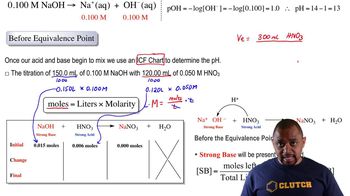
 05:47
05:47