Skip to main content
Analytical Chemistry
My Course
Learn
Exam Prep
AI Tutor
Study Guides
Flashcards
Explore
Try the app
My Course
Learn
Exam Prep
AI Tutor
Study Guides
Flashcards
Explore
Try the app
Back
The End Point quiz
You can tap to flip the card.
What does the endpoint represent in an acid-base titration?
You can tap to flip the card.
👆
What does the endpoint represent in an acid-base titration?
The endpoint is the range where the indicator changes color, used as an estimate for the equivalence point where moles of acid equal moles of base.
Track progress
Control buttons has been changed to "navigation" mode.
1/15
Related flashcards
Related practice
Recommended videos
The End Point quiz #1
The End Point
10 Terms
The End Point definitions
The End Point
15 Terms
The End Point
15. Redox Titrations
5 problems
Topic
Analyte Oxidation State
15. Redox Titrations
5 problems
Topic
15. Redox Titrations
4 topics
12 problems
Chapter
Guided course
07:27
The End Point
300
views
Terms in this set (15)
Hide definitions
What does the endpoint represent in an acid-base titration?
The endpoint is the range where the indicator changes color, used as an estimate for the equivalence point where moles of acid equal moles of base.
How is the endpoint detected in a redox titration?
In redox titrations, the endpoint is detected using indicators and electrodes, indicated by a significant change in the solution's potential.
What causes a color change in a redox indicator during titration?
A color change occurs when the indicator undergoes a change in oxidation state, either being reduced or oxidized by the titrant.
What is the role of an oxidizing agent in a redox titration?
An oxidizing agent removes electrons from the indicator, causing it to be oxidized and potentially change color.
How does a reducing agent affect a redox indicator?
A reducing agent adds electrons to the indicator, reducing it and possibly causing a color change.
What equation is used to calculate the cell potential in redox titrations under non-standard conditions?
The Nernst equation is used, which relates cell potential to the ratio of reduced and oxidized forms of the indicator.
What is the ideal range for the ratio of reduced to oxidized forms of a redox indicator for effective measurement?
The ideal range is when the log of the ratio is between -1 and +1, meaning the concentrations differ by no more than a factor of 10.
Why should the indicator transition range overlap the sharpest increase in potential on the titration curve?
This ensures the indicator changes color at the point closest to the equivalence point, providing an accurate endpoint.
What is a Gran plot and how is it used in titrations?
A Gran plot uses the first derivative of potential versus volume to help pinpoint the endpoint in titrations.
In the example with Fe2+ and Ce4+, which indicator is better for determining the endpoint and why?
The second indicator is better because its color change coincides with the largest increase in potential, accurately marking the endpoint.
How does the Nernst equation for a redox indicator resemble the Henderson-Hasselbalch equation?
Both equations use a ratio of two forms (reduced/oxidized or base/acid) and are most accurate when this ratio is within a factor of 10.
What does the endpoint signify in a redox titration?
It signifies the state where the indicator changes from its oxidized to reduced form, marked by a color change.
How can you visually estimate the endpoint on a titration curve?
Look for the sharpest increase in potential (for redox) or pH (for acid-base) and see where the indicator changes color.
What happens to the indicator when the titrant is an oxidizing agent?
The indicator is oxidized, meaning it loses electrons, which can cause a color change.
Why is it important for the indicator's color change to occur near the equivalence point?
Because this ensures the measured endpoint closely matches the true equivalence point, improving titration accuracy.
 BackBack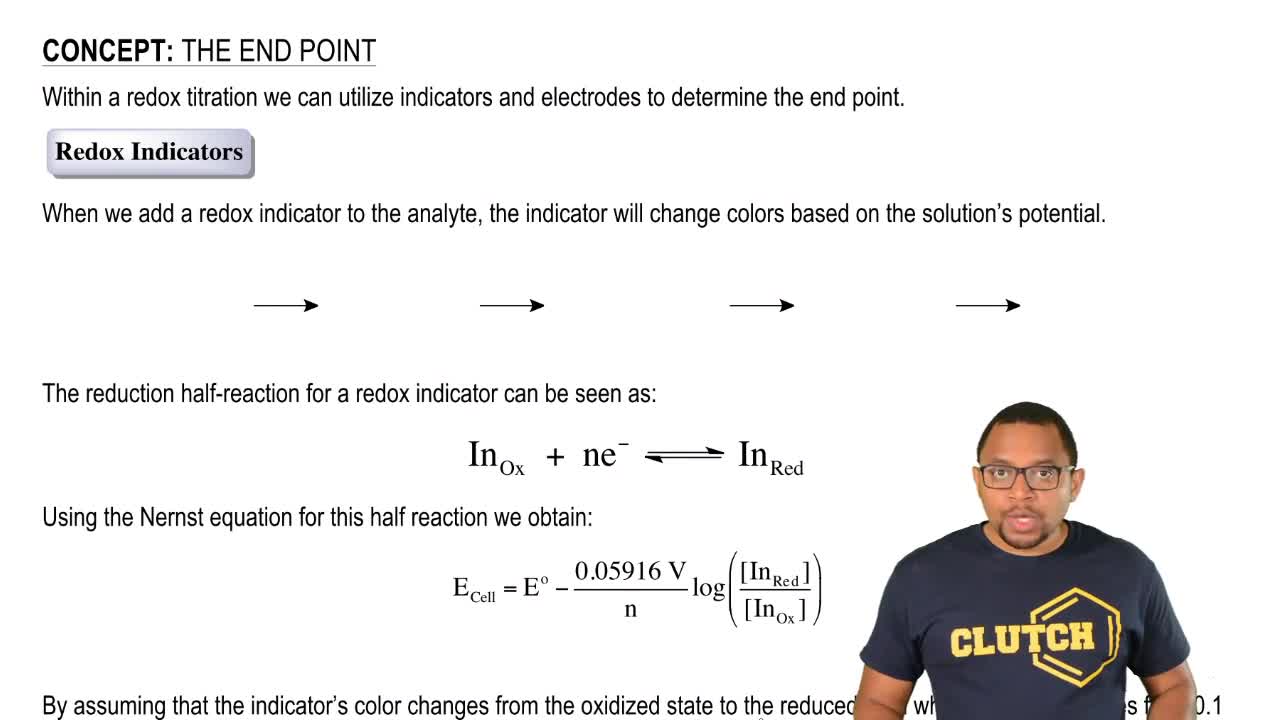
 07:27
07:27