Back

The Reaction Quotient definitions

Control buttons has been changed to "navigation" mode.
1/15
  • Reaction Quotient

    A calculated ratio of product to reactant concentrations used to assess if a system is at equilibrium.
  • Equilibrium Constant

    A fixed value representing the ratio of products to reactants at equilibrium for a given reaction.
  • Equilibrium

    A state where the rates of the forward and reverse reactions are equal, resulting in no net change in concentrations.
  • Forward Direction

    The process in which reactants are converted into products as a reaction shifts to reach equilibrium.
  • Reverse Direction

    The process in which products are converted back into reactants as a reaction shifts to reach equilibrium.
  • Products

    Substances formed as a result of a chemical reaction, appearing in the numerator of the reaction quotient.
  • Reactants

    Starting substances in a chemical reaction, appearing in the denominator of the reaction quotient.
  • Number Line

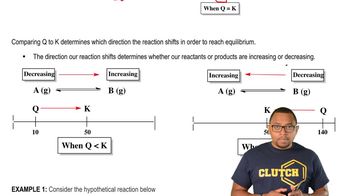
    A visual tool used to represent the relative values of Q and K and the direction of the reaction shift.
  • Shifting

    The process by which a reaction moves toward equilibrium, altering the amounts of reactants and products.
  • Balance

    A concept describing how an increase on one side of a reaction corresponds to a decrease on the other.
  • Expression

    A mathematical formula representing the ratio of product and reactant concentrations for Q or K.
  • Concentration

    The amount of a substance present in a given volume, used to calculate Q and K.
  • Solids

    A phase of matter excluded from the calculation of Q and K due to constant concentration.
  • Liquids

    A phase of matter ignored in Q and K calculations because their concentration remains unchanged.
  • Direction

    The way in which a reaction proceeds—either toward products or reactants—to achieve equilibrium.