
Ch. 24 The Urinary System
Chapter 24, Problem 6

Which of the following substances would pass through the filtration membrane to become part of the filtrate under normal circumstances? (Circle all that apply.)
a. Sodium ions
b. Albumin
c. Glucose
d. Erythrocytes
e. Leukocytes
f. Amino acids
g. Urea

Verified step by step guidance
1
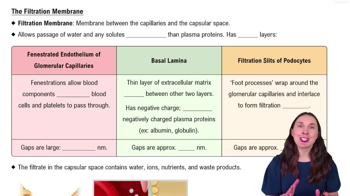
Understand the structure and function of the filtration membrane in the renal corpuscle. The filtration membrane consists of three layers: the fenestrated endothelium of glomerular capillaries, the basement membrane, and the filtration slits formed by podocytes. It allows small molecules to pass while preventing the passage of larger molecules and cells.
Recall the size and charge selectivity of the filtration membrane. Small solutes like ions, glucose, and urea can pass through, while larger molecules like proteins (e.g., albumin) and cells (e.g., erythrocytes and leukocytes) are typically too large to pass under normal circumstances.
Analyze each substance listed in the question: a. Sodium ions are small and positively charged, so they can pass through the filtration membrane. b. Albumin is a large protein and is normally too large to pass through. c. Glucose is a small molecule and can pass through. d. Erythrocytes (red blood cells) are too large to pass through. e. Leukocytes (white blood cells) are also too large to pass through. f. Amino acids are small molecules and can pass through. g. Urea is a small waste product and can pass through.
Identify the substances that can pass through the filtration membrane under normal circumstances: sodium ions, glucose, amino acids, and urea. Exclude albumin, erythrocytes, and leukocytes as they are too large to pass through.
Conclude that the substances that would pass through the filtration membrane to become part of the filtrate under normal circumstances are sodium ions, glucose, amino acids, and urea.

Verified video answer for a similar problem:

This video solution was recommended by our tutors as helpful for the problem above.
Was this helpful?

Key Concepts

Here are the essential concepts you must grasp in order to answer the question correctly.

Filtration Membrane

The filtration membrane is a selective barrier in the kidneys, specifically in the glomerulus, that allows certain substances to pass into the filtrate while retaining larger molecules and cells. It consists of three layers: the fenestrated endothelium, the basement membrane, and the podocytes. This structure is crucial for maintaining the balance of fluids and electrolytes in the body.
Recommended video:
4:30
The Filtration Membane

Substance Size and Charge

The ability of a substance to pass through the filtration membrane is largely determined by its size and charge. Small molecules, such as sodium ions, glucose, and urea, can easily pass through, while larger molecules like albumin and cells (erythrocytes and leukocytes) are typically retained. This selective permeability is essential for proper kidney function and homeostasis.
Recommended video:
03:45
3 Size Classes of Carbohydrates

Normal Filtrate Composition

Normal filtrate composition includes water, electrolytes, and small organic molecules, which are essential for bodily functions. Substances like glucose, amino acids, and urea are typically found in the filtrate, while proteins and blood cells are not. Understanding what constitutes normal filtrate helps in diagnosing kidney function and potential disorders.
Recommended video:
3:43
Normal Microbiota