Back

Anion-Exchange Chromatography definitions

Control buttons has been changed to "navigation" mode.
1/15
  • Anion

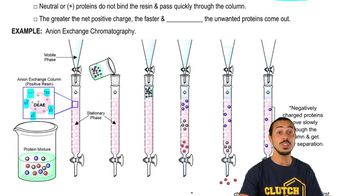
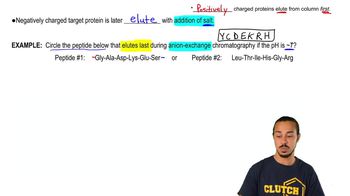
    A negatively charged particle that interacts with positively charged resins during purification.
  • Stationary Phase

    A fixed material inside the column, often containing positive charges, that binds target proteins.
  • Diethylaminoethyl (DEAE)

    A functional group providing positive charges to resins, enhancing protein binding in purification.
  • Resin

    Beads within the column that carry functional groups, facilitating protein separation based on charge.
  • Mobile Phase

    A liquid added to the column, enabling movement and separation of proteins through the stationary phase.
  • Elution

    The process by which proteins exit the column, often accelerated by salt addition to disrupt interactions.
  • Net Charge

    The overall electrical charge of a protein, determining its interaction and movement within the column.
  • Electrostatic Interaction

    The attraction between oppositely charged molecules, crucial for protein binding in chromatography.
  • Column Chromatography

    A technique using a packed column to separate molecules based on physical or chemical properties.
  • Protein Mixture

    A solution containing proteins with varying charges, subject to separation during chromatography.
  • Purification

    The process of isolating specific proteins from a mixture, often based on charge differences.
  • Salt

    A compound added to weaken ionic interactions, facilitating the release of bound proteins from the resin.
  • Ionic Interaction

    A force between charged groups, dictating protein binding and separation efficiency in the column.
  • Neutral Protein

    A protein lacking net charge, eluting from the column after positively charged proteins.
  • Cation Exchange Chromatography

    A related technique where negatively charged resins bind positively charged proteins for separation.