Back

Anion-Exchange Chromatography quiz

Control buttons has been changed to "navigation" mode.
1/15
  • What type of proteins does anion exchange chromatography purify?

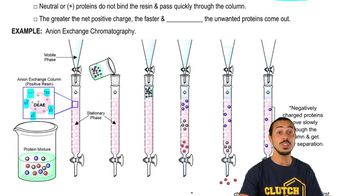
    Anion exchange chromatography purifies negatively charged proteins.
  • What is the charge of the stationary phase in anion exchange chromatography?

    The stationary phase is positively charged.
  • Which functional group is commonly used in the stationary phase of anion exchange chromatography?

    Diethylaminoethyl (DEAE) functional groups are commonly used.
  • How do negatively charged proteins interact with the stationary phase in anion exchange chromatography?

    They bind to the positively charged resin via charge–charge (electrostatic) interactions.
  • Which proteins elute first from an anion exchange chromatography column?

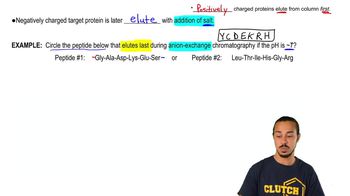
    Positively charged proteins elute first because they do not interact with the positively charged resin.
  • What happens to neutral proteins during anion exchange chromatography?

    Neutral proteins elute second, after the positively charged proteins, because they have minimal interaction with the resin.
  • Why do negatively charged proteins move slowly through the column?

    They interact strongly with the positively charged stationary phase, causing them to move slowly.
  • How can you elute the bound negatively charged proteins from the column more quickly?

    By adding salt, which disrupts the ionic interactions and allows the proteins to elute.
  • What is exchanged in anion exchange chromatography?

    Anions (negatively charged ions) are exchanged between the stationary phase and the protein mixture.
  • What type of chromatography is anion exchange chromatography an example of?

    It is an example of ion-exchange chromatography, which is a type of column chromatography.
  • How does the net negative charge of a protein affect its movement through the column?

    Proteins with a greater net negative charge move more slowly because they interact more strongly with the resin.
  • What is the purpose of continuously adding mobile phase during the process?

    It helps to separate the protein mixture based on their charges as they move through the column.
  • Why is anion exchange chromatography not used to purify positively charged proteins?

    Because positively charged proteins do not bind to the positively charged resin and elute too quickly for effective purification.
  • What effect does salt have on the interaction between proteins and the stationary phase?

    Salt decreases the strength of ionic interactions, allowing bound proteins to elute from the column.
  • How can knowledge of one type of ion exchange chromatography help you understand the other?

    By swapping the charges (positive for negative and vice versa), you can apply the principles of one type to the other.