Back

Ion-Exchange Chromatography definitions

Control buttons has been changed to "navigation" mode.
1/15
  • Ion Exchange Chromatography

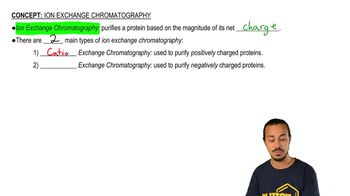
    Column technique separating proteins based on net charge, using charged resins to selectively retain target molecules.
  • Column Chromatography

    Method where mixtures pass through a packed column, enabling separation based on physical or chemical properties.
  • Cation Exchange Chromatography

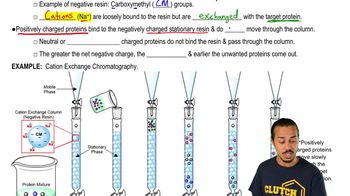
    Process using a negatively charged resin to purify positively charged proteins by exchanging pre-bound cations.
  • Anion Exchange Chromatography

    Technique employing a positively charged resin to isolate negatively charged proteins from a mixture.
  • Stationary Phase

    Immobile component in a column, often resin beads, providing charged surfaces for protein binding and separation.
  • Resin

    Beads forming the stationary phase, functionalized with charged groups to facilitate protein binding in chromatography.
  • Carboxymethyl Group

    Negatively charged functional group attached to resin beads, commonly used in cation exchange columns.
  • Mobile Phase

    Liquid continuously added to the column, carrying proteins through and enabling their separation based on charge.
  • Elution

    Process of washing out proteins from the column, often accelerated by adding salt to disrupt ionic interactions.
  • Ionic Interaction

    Electrostatic attraction between oppositely charged molecules, crucial for protein retention in ion exchange columns.
  • Net Charge

    Overall electrical charge of a protein, determining its binding affinity to the charged resin in chromatography.
  • Protein Purification

    Isolation of target proteins from a mixture, achieved by exploiting differences in charge using chromatography.
  • Sodium Ion

    Positively charged cation pre-bound to resin beads, exchanged with target proteins during cation exchange chromatography.
  • Separation Efficiency

    Degree to which proteins are resolved based on charge, enhanced by strong interactions with the stationary phase.
  • Salt

    Compound added to the mobile phase to weaken ionic interactions, facilitating rapid elution of bound proteins.