Back

Ion-Exchange Chromatography quiz

Control buttons has been changed to "navigation" mode.
1/15
  • What is the main principle behind ion exchange chromatography?

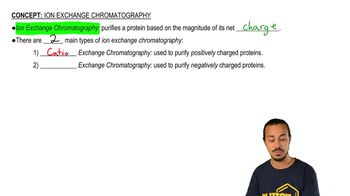
    Ion exchange chromatography separates proteins based on their net charge using a charged stationary phase.
  • What are the two main types of ion exchange chromatography?

    The two main types are cation exchange chromatography and anion exchange chromatography.
  • Which type of proteins does cation exchange chromatography purify?

    Cation exchange chromatography is used to purify positively charged proteins.
  • What type of stationary phase is used in cation exchange chromatography?

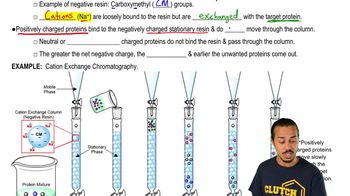
    A negatively charged stationary phase, often with carboxymethyl groups, is used in cation exchange chromatography.
  • Why is it called 'cation exchange' chromatography?

    It's called cation exchange because loosely bound cations on the resin are exchanged with positively charged target proteins during the process.
  • What happens to negatively charged and neutral proteins in cation exchange chromatography?

    Negatively charged and neutral proteins do not bind to the negatively charged resin and elute from the column faster.
  • How are positively charged proteins retained in the column during cation exchange chromatography?

    They bind to the negatively charged stationary resin and move much more slowly through the column.
  • What is the role of carboxymethyl (CM) groups in cation exchange chromatography?

    Carboxymethyl groups provide negative charges on the resin, allowing it to bind positively charged proteins.
  • Which proteins elute first from a cation exchange chromatography column?

    Negatively charged proteins elute first because they do not interact with the negatively charged resin.
  • How can you elute positively charged proteins from the column after other proteins have been washed out?

    Adding salt weakens the ionic interactions, allowing the positively charged proteins to be eluted more quickly.
  • Why do proteins with a greater positive charge move more slowly through the column?

    They interact more strongly with the negatively charged stationary phase, causing them to move slower.
  • What is the effect of continuously adding mobile phase during cation exchange chromatography?

    It helps separate proteins based on their charge, with unwanted proteins eluting first and target proteins retained longer.
  • Why does cation exchange chromatography provide better separation for positively charged proteins?

    Because positively charged proteins have more interactions with the stationary and mobile phases, leading to better separation.
  • In a mixture, which protein would elute first: one with a net charge of -4 or one with +2?

    The protein with a net charge of -4 would elute first because it is negatively charged and does not bind to the resin.
  • What is the stationary phase in ion exchange chromatography typically made of?

    It is typically made of resin beads with charged functional groups, such as carboxymethyl groups for cation exchange.