Back

Peptide Bond definitions

Control buttons has been changed to "navigation" mode.
1/15
  • Peptide Bond

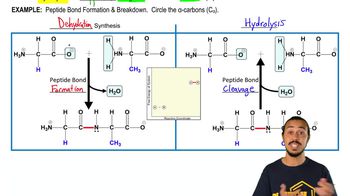
    An amide linkage joining amino acids in a polypeptide, marked by a carbonyl group connected to nitrogen.
  • Amide

    A functional group featuring a carbonyl group bonded to a nitrogen atom, central to peptide bond structure.
  • Polypeptide Chain

    A sequence of amino acids linked by peptide bonds, forming the backbone of proteins.
  • Dehydration Synthesis

    A reaction removing water to connect amino acids, requiring energy and resulting in peptide bond formation.
  • Hydrolysis

    A process adding water to break peptide bonds, releasing energy and separating amino acids.
  • Alpha Carbon

    The central carbon atom in an amino acid, attached to the R group and key functional groups.
  • Carboxyl Group

    A functional group (-COOH) in amino acids, participating in peptide bond formation.
  • Amino Group

    A functional group (-NH2) in amino acids, reacting with carboxyl groups during peptide bond creation.
  • R Group

    The variable side chain attached to the alpha carbon, defining amino acid identity.
  • Glycine

    An amino acid with a hydrogen as its R group, often used in peptide bond examples.
  • Alanine

    An amino acid with a methyl group as its R group, commonly illustrated in peptide bond formation.
  • Dipeptide

    A molecule consisting of two amino acids joined by a single peptide bond.
  • ATP

    A molecule providing energy for endergonic reactions such as peptide bond formation.
  • Energy Barrier

    A high threshold preventing rapid peptide bond hydrolysis, ensuring protein stability.
  • Exergonic Process

    A reaction releasing energy, such as peptide bond hydrolysis, often spontaneous but slow.