Textbook Question
Fill in the blanks in this summary map to help you review the key concepts of cellular respiration.
<IMAGE>
2523
views



 Taylor, Simon, Dickey, Hogan 10th EditionCh. 6 How Cells Harvest Chemical EnergyProblem 3
 Verified step by step guidance
 05:04
05:04
 04:38
04:38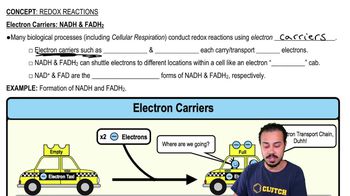 05:22
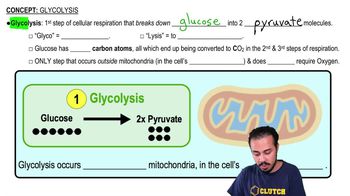
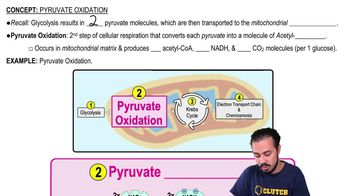
05:22Fill in the blanks in this summary map to help you review the key concepts of cellular respiration.
<IMAGE>
A biochemist wanted to study how various substances were used in cellular respiration. In one experiment, she allowed a mouse to breathe air containing O₂ 'labeled' by a particular isotope. In the mouse, the labeled oxygen first showed up in
a. ATP
b. NADH
c. CO₂
d. H₂O
Most of the CO₂ from cellular respiration is released during
a. Stage 1: Glycolysis
b. Stage 2: Pyruvate oxidation
c. Stage 2: The citric acid cycle
d. Stage 3: Oxidative phosphorylation
Which of the following is the most immediate source of energy for making most of the ATP in your cells?
a. The transfer of from intermediate substrates to ADP
b. The movement of H⁺ across a membrane down its concentration gradient
c. The splitting of glucose into two molecules of pyruvate
d. Electrons moving through the electron transport chain
Which of the following is a distinction between cellular respiration and fermentation?
a. The transfer of from intermediate substrates to ADP
b. The movement of H+ across a membrane down its concentration gradient
c. The splitting of glucose into two molecules of pyruvate
d. Electrons moving through the electron transport chain