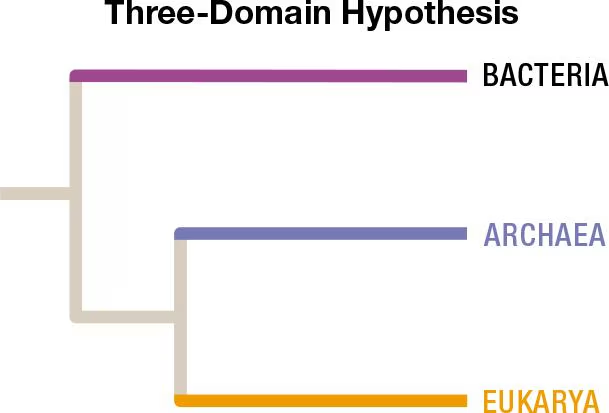
The traditional tree of life (shown above) presents the three domains as distinct, monophyletic lineages. However, other hypotheses propose different views on the relationships among the Archaea, Bacteria, and Eukarya. In particular, the two-domain hypothesis—or eocyte hypothesis—is emerging as a well-supported alternative to the three-domain hypothesis. The eocyte hypothesis, illustrated below, suggests that eukaryotes evolved from eocytes (also known as the Crenarchaeota—a major lineage of the Archaea). Resolving the relationships among these ancient lineages is difficult, but it has profound implications on our understanding of the origin of eukaryotic cells. What other types of evidence or features might be used to ascertain whether the tree of life is best represented according to the three-domain or the eocyte hypothesis?
Verified step by step guidance
1
Examine the genetic evidence: Compare the genomes of eukaryotes, eocytes (Crenarchaeota), and other archaea to identify shared genes or unique genetic markers that might indicate evolutionary relationships.
Analyze ribosomal RNA sequences: Ribosomal RNA (rRNA) is highly conserved and can provide insights into evolutionary relationships. Compare rRNA sequences across the three domains to see if eukaryotes are more closely related to eocytes than other archaea.
Investigate cellular structures: Look for similarities in cellular structures, such as membrane lipids or organelles, between eukaryotes and eocytes that might support the eocyte hypothesis.
Consider metabolic pathways: Compare the metabolic pathways of eukaryotes, eocytes, and other archaea to identify any shared or unique pathways that could suggest evolutionary connections.
Review fossil records: Examine the fossil record for evidence of early eukaryotic life and its potential connections to eocytes, considering the timing and environmental conditions that might have influenced evolutionary paths.
Verified video answer for a similar problem:
This video solution was recommended by our tutors as helpful for the problem above
Video duration:
1m
Play a video:
Was this helpful?
Key Concepts
Here are the essential concepts you must grasp in order to answer the question correctly.
Three-Domain Hypothesis
The Three-Domain Hypothesis classifies all life into three major domains: Bacteria, Archaea, and Eukarya. This model suggests that these domains represent distinct evolutionary lineages, with Archaea and Eukarya being more closely related to each other than to Bacteria. This classification is based on genetic, biochemical, and morphological characteristics, highlighting the diversity of life forms and their evolutionary relationships.
The Eocyte Hypothesis, also known as the two-domain hypothesis, proposes that Eukarya evolved from a specific lineage of Archaea called eocytes or Crenarchaeota. This hypothesis challenges the traditional three-domain model by suggesting that the evolutionary relationship between Eukarya and Archaea is more direct, indicating a closer evolutionary link. This perspective emphasizes the importance of genetic and molecular evidence in understanding the origins of complex life forms.
Molecular evidence, such as DNA and RNA sequencing, plays a crucial role in phylogenetics, the study of evolutionary relationships among organisms. By comparing genetic material across different species, scientists can infer evolutionary lineages and assess the validity of hypotheses like the three-domain and eocyte models. This evidence can reveal similarities and differences in genetic sequences, providing insights into the evolutionary history and relationships among Bacteria, Archaea, and Eukarya.