Pearson+ LogoPearson+ Logo
Ch. 1 Biology: The Study of Scientific Life
Taylor - Campbell Biology: Concepts & Connections 10th Edition
Taylor, Simon, Dickey, Hogan10th EditionCampbell Biology: Concepts & ConnectionsISBN: 9780136538783Not the one you use?Change textbook
Chapter 1, Problem 16d

The graph below shows the results of an experiment in which mice learned to run through a maze.
Do the data support the hypothesis? Explain.
Graph showing average maze completion time for mice with and without food reward over six days.

Verified step by step guidance
1
Examine the graph carefully. It shows the average time (in minutes) taken by mice to complete a maze over six days under two conditions: 'No reward' (red line) and 'Food reward' (blue line).
Identify the trend in the data. For the 'Food reward' group, the average time to complete the maze decreases steadily from Day 1 to Day 6, indicating improvement in performance. For the 'No reward' group, the average time also decreases but at a slower rate, and it plateaus after Day 4.
Interpret the data in relation to the hypothesis. If the hypothesis states that rewards (like food) improve learning or performance, the data support this hypothesis because the 'Food reward' group shows a faster and more consistent decrease in maze completion time compared to the 'No reward' group.
Consider alternative explanations or factors. The difference in performance could be due to motivation provided by the food reward, which encourages the mice to learn the maze faster. The 'No reward' group may lack this motivation, leading to slower improvement.
Conclude based on the evidence. The data support the hypothesis that food rewards enhance learning and performance in maze navigation, as evidenced by the faster reduction in completion time for the 'Food reward' group compared to the 'No reward' group.

Verified video answer for a similar problem:

This video solution was recommended by our tutors as helpful for the problem above.
Video duration:
43s
Was this helpful?

Key Concepts

Here are the essential concepts you must grasp in order to answer the question correctly.

Learning and Memory

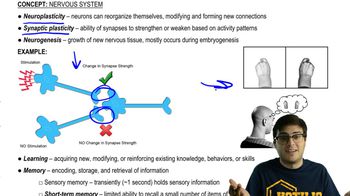
Learning is the process through which organisms acquire new information or skills, while memory refers to the ability to store and retrieve that information. In the context of the maze experiment, the mice's ability to navigate the maze more quickly over time indicates that they are learning the task and forming memories associated with the maze layout.
Recommended video:
Guided course
07:41
Neuroplasticity, Learning, and Memory

Behavioral Reinforcement

Behavioral reinforcement is a principle in psychology where a behavior is strengthened or increased by the presence of a reward. In this experiment, the mice that received a food reward demonstrated a more significant decrease in maze completion time compared to those without a reward, suggesting that the food acted as a positive reinforcement, motivating them to learn the maze more effectively.
Recommended video:

Experimental Design

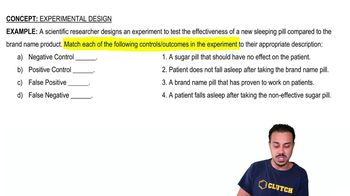
Experimental design refers to the structured approach used to test hypotheses through controlled experiments. In this case, the design includes two groups of mice (with and without food rewards) and measures their performance over several days, allowing for a comparison of learning rates and the impact of rewards on behavior, which is crucial for evaluating the hypothesis.
Recommended video:
Guided course
02:50
Experimental Design Example 1