Pearson+ LogoPearson+ Logo
Ch. 1 Biology: The Study of Scientific Life
Taylor - Campbell Biology: Concepts & Connections 10th Edition
Taylor, Simon, Dickey, Hogan10th EditionCampbell Biology: Concepts & ConnectionsISBN: 9780136538783Not the one you use?Change textbook
Chapter 1, Problem 17

Suppose that in an experiment similar to the camouflage experiment described in Module 1.5, a researcher observed and recorded more total predator attacks on dark-model mice in the inland habitat than on dark models in the beach habitat. From comparing these two pieces of data, the researcher concluded that the camouflage hypothesis is false.
Do you think this conclusion is justified? Why or why not?

Verified step by step guidance
1
Understand the camouflage hypothesis: The hypothesis suggests that animals with coloration matching their environment are less likely to be attacked by predators because they are harder to detect.
Analyze the data provided: The researcher observed more predator attacks on dark-model mice in the inland habitat compared to dark models in the beach habitat. This data alone does not directly test the camouflage hypothesis but rather compares attack rates between two different environments.
Consider the experimental design: To test the camouflage hypothesis, the researcher should compare predator attack rates on dark-model mice versus light-model mice within the same habitat (e.g., inland or beach). Comparing attack rates across habitats introduces confounding variables, such as differences in predator types or environmental conditions.
Evaluate the conclusion: The researcher’s conclusion that the camouflage hypothesis is false is not justified based on the data provided. The data does not directly test whether dark-model mice are better camouflaged in one habitat compared to another; it only shows differences in attack rates across habitats.
Suggest improvements: To properly test the camouflage hypothesis, the researcher should conduct an experiment comparing predator attack rates on dark-model mice and light-model mice within each habitat separately, ensuring that other variables are controlled.

Verified video answer for a similar problem:

This video solution was recommended by our tutors as helpful for the problem above.
Video duration:
1m
Was this helpful?

Key Concepts

Here are the essential concepts you must grasp in order to answer the question correctly.

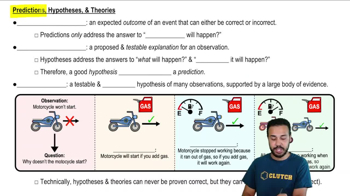
Camouflage Hypothesis

The camouflage hypothesis posits that organisms with coloration or patterns that blend into their environment are less likely to be detected and attacked by predators. This concept is fundamental in understanding natural selection, as it suggests that advantageous traits can enhance survival and reproductive success. In the context of the experiment, the effectiveness of camouflage in different habitats is crucial for evaluating predator-prey interactions.
Recommended video:
Guided course
08:22
Predictions, Hypotheses, & Theories

Predator-Prey Dynamics

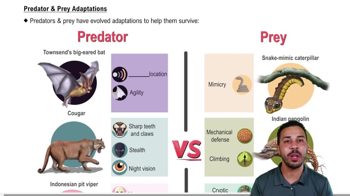
Predator-prey dynamics refer to the interactions between predators and their prey, which can influence population sizes and behaviors. These dynamics are shaped by various factors, including habitat, availability of resources, and the physical characteristics of both predators and prey. Understanding these interactions is essential for interpreting the results of the experiment, as different habitats may affect predator behavior and prey vulnerability.
Recommended video:
Guided course
03:01
Predator & Prey Adaptations

Experimental Design and Interpretation

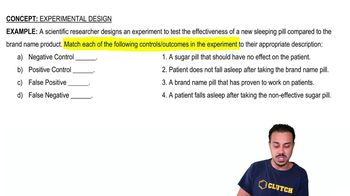
Experimental design involves planning how to conduct an experiment to test a hypothesis effectively. It includes selecting appropriate controls, variables, and methods of data collection. In this case, the interpretation of the results must consider factors such as sample size, environmental conditions, and potential biases. A justified conclusion requires careful analysis of these elements to determine if the observed differences in predator attacks are significant and what they imply about the camouflage hypothesis.
Recommended video:
Guided course
02:50
Experimental Design Example 1