
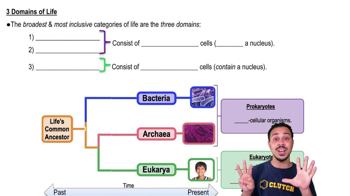
The traditional tree of life (shown above) presents the three domains as distinct, monophyletic lineages. However, other hypotheses propose different views on the relationships among the Archaea, Bacteria, and Eukarya. In particular, the two-domain hypothesis—or eocyte hypothesis—is emerging as a well-supported alternative to the three-domain hypothesis. The eocyte hypothesis, illustrated below, suggests that eukaryotes evolved from eocytes (also known as the Crenarchaeota—a major lineage of the Archaea). Resolving the relationships among these ancient lineages is difficult, but it has profound implications on our understanding of the origin of eukaryotic cells. Evaluate this statement: According to the two-domain hypothesis, all members of the domain Archaea are prokaryotes and therefore lack membrane-bound nuclei.
Verified step by step guidance
1
Begin by understanding the two-domain hypothesis, which suggests that eukaryotes evolved from a specific group within the Archaea known as Crenarchaeota or eocytes.
Examine the image provided, which illustrates the two-domain hypothesis. Notice that the Archaea are divided into 'Other archaea' and 'Crenarchaeota (eocytes)', with Eukaryota branching from the Crenarchaeota.
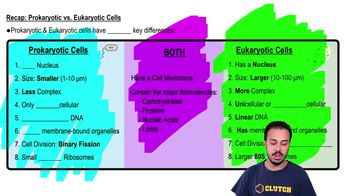
Recall that prokaryotes, including Archaea, are characterized by the absence of membrane-bound nuclei. This is a fundamental trait of prokaryotic cells.
Consider the implications of the two-domain hypothesis: while it suggests a close evolutionary relationship between eukaryotes and eocytes, it does not change the fact that all Archaea, including eocytes, are prokaryotic and lack membrane-bound nuclei.
Conclude that according to the two-domain hypothesis, all members of the domain Archaea, including those from which eukaryotes are proposed to have evolved, are indeed prokaryotes and lack membrane-bound nuclei.
Verified video answer for a similar problem:
This video solution was recommended by our tutors as helpful for the problem above
Video duration:
1m
Play a video:
Was this helpful?
Key Concepts
Here are the essential concepts you must grasp in order to answer the question correctly.
Three-Domain Hypothesis
The Three-Domain Hypothesis classifies all life into three major domains: Bacteria, Archaea, and Eukarya. This model suggests that these domains are distinct and monophyletic, meaning they each share a common ancestor. It emphasizes the fundamental differences between prokaryotic organisms (Bacteria and Archaea) and eukaryotic organisms (Eukarya), particularly in cellular structure and genetic organization.
The Two-Domain Hypothesis, also known as the eocyte hypothesis, proposes that Eukarya evolved from a specific lineage of Archaea called eocytes. This model suggests that instead of being a separate domain, Eukarya is nested within Archaea, indicating a closer evolutionary relationship. This hypothesis challenges the traditional view of the Three-Domain model and has implications for understanding the origin of complex cellular structures in eukaryotes.
Prokaryotes are unicellular organisms that lack a membrane-bound nucleus and other organelles, while eukaryotes have a defined nucleus and complex cellular structures. All members of the domain Archaea are classified as prokaryotes, which means they do not possess membrane-bound nuclei. This distinction is crucial for understanding the fundamental differences in cellular organization and function between these two groups of organisms.