Pearson+ LogoPearson+ Logo
Ch. 26 - Bacteria and Archaea
Freeman - Biological Science 7th Edition
Freeman7th EditionBiological ScienceISBN: 9783584863285Not the one you use?Change textbook
Chapter 26, Problem 12

Three-domain hypothesis tree diagram showing Bacteria, Archaea, and Eukarya as distinct monophyletic lineages.
The traditional tree of life (shown above) presents the three domains as distinct, monophyletic lineages. However, other hypotheses propose different views on the relationships among the Archaea, Bacteria, and Eukarya. In particular, the two-domain hypothesis—or eocyte hypothesis—is emerging as a well-supported alternative to the three-domain hypothesis. The eocyte hypothesis, illustrated below, suggests that eukaryotes evolved from eocytes (also known as the Crenarchaeota—a major lineage of the Archaea). Resolving the relationships among these ancient lineages is difficult, but it has profound implications on our understanding of the origin of eukaryotic cells.
Diagram illustrating the Two-Domain Hypothesis showing relationships among Bacteria, Archaea, and Eukaryota.
The Bacteria and Archaea both include microscopic prokaryotes that lack membrane-bound nuclei. What criteria have led to the classification of these two groups as separate domains?

Verified step by step guidance
1
Understand the traditional classification: The traditional tree of life classifies life into three domains: Bacteria, Archaea, and Eukarya. This classification is based on differences in cell structure, genetics, and biochemistry.
Identify the key differences between Bacteria and Archaea: Although both are prokaryotes, they differ in several fundamental ways. Bacteria have peptidoglycan in their cell walls, while Archaea do not. Archaea have unique lipids in their cell membranes and distinct ribosomal RNA sequences.
Explore the two-domain hypothesis: The two-domain hypothesis, or eocyte hypothesis, suggests that Eukaryotes evolved from a subgroup of Archaea called Crenarchaeota (eocytes). This hypothesis challenges the traditional view by proposing that Eukaryotes are more closely related to Archaea than to Bacteria.
Analyze the implications of the two-domain hypothesis: If Eukaryotes evolved from Archaea, it suggests a closer evolutionary relationship between these two groups. This has implications for understanding the origin of complex cellular structures found in Eukaryotes.
Consider the criteria for domain classification: The classification into separate domains is based on genetic, biochemical, and structural differences. These include differences in cell wall composition, membrane lipids, and genetic machinery, which justify the separation of Bacteria and Archaea into distinct domains.

Verified video answer for a similar problem:

This video solution was recommended by our tutors as helpful for the problem above.
Video duration:
1m
Was this helpful?

Key Concepts

Here are the essential concepts you must grasp in order to answer the question correctly.

Three-Domain Hypothesis

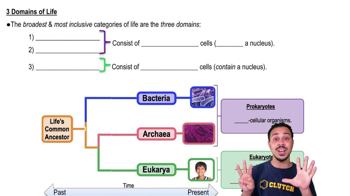
The Three-Domain Hypothesis classifies all life into three distinct domains: Bacteria, Archaea, and Eukarya. This classification is based on genetic and biochemical differences, particularly in ribosomal RNA sequences. Each domain represents a monophyletic lineage, indicating that all members share a common ancestor. This framework has been fundamental in understanding evolutionary relationships among organisms.
Recommended video:
Guided course
05:20
3 Domains of Life

Two-Domain Hypothesis (Eocyte Hypothesis)

The Two-Domain Hypothesis, also known as the eocyte hypothesis, proposes that Eukarya evolved from a specific lineage of Archaea called eocytes. This hypothesis challenges the traditional Three-Domain model by suggesting that the evolutionary relationship between Archaea and Eukarya is closer than previously thought. It emphasizes the importance of genetic and molecular evidence in understanding the origins of complex life forms.
Recommended video:
Guided course
08:22
Predictions, Hypotheses, & Theories

Prokaryotic vs. Eukaryotic Cells

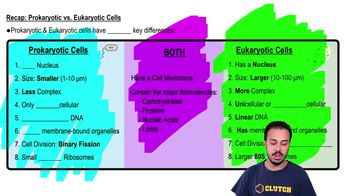
Prokaryotic cells, which include Bacteria and Archaea, are characterized by the absence of a membrane-bound nucleus and organelles. In contrast, eukaryotic cells possess a defined nucleus and various organelles, allowing for greater complexity and specialization. Understanding these fundamental differences is crucial for classifying organisms and studying their evolutionary relationships, particularly in the context of the Three-Domain and Two-Domain hypotheses.
Recommended video:
Guided course
04:26
Recap: Prokaryotic vs. Eukaryotic Cells
Related Practice
Textbook Question
Streptococcus mutans obtains energy by oxidizing sucrose. This bacterium is abundant in the mouths of Western European and North American children and is a prominent cause of cavities. The organism is virtually absent in children from East Africa, where tooth decay is rare. Propose a hypothesis to explain this observation. Outline the design of a study that would test your hypothesis.
1305
views
Textbook Question

Suppose that you've been hired by a firm interested in using bacteria to clean up organic solvents found in toxic waste dumps. Your new employer is particularly interested in finding cells that are capable of breaking a molecule called benzene into less-toxic compounds. Where would you go to look for bacteria that can metabolize benzene as an energy or carbon source? How would you design an enrichment culture capable of isolating benzene-metabolizing species?

860
views
Textbook Question

The traditional tree of life (shown above) presents the three domains as distinct, monophyletic lineages. However, other hypotheses propose different views on the relationships among the Archaea, Bacteria, and Eukarya. In particular, the two-domain hypothesis—or eocyte hypothesis—is emerging as a well-supported alternative to the three-domain hypothesis. The eocyte hypothesis, illustrated below, suggests that eukaryotes evolved from eocytes (also known as the Crenarchaeota—a major lineage of the Archaea). Resolving the relationships among these ancient lineages is difficult, but it has profound implications on our understanding of the origin of eukaryotic cells.

Why are Archaea considered a monophyletic group according to the three-domain hypothesis?

a. Because this group includes all organisms except eukaryotes.

b. Because this group includes an ancestral population and all of its descendants.

c. Because all members of this group lack membrane-bound organelles.

d. Because this group evolved after the origin of bacteria.

2119
views
Textbook Question

The traditional tree of life (shown above) presents the three domains as distinct, monophyletic lineages. However, other hypotheses propose different views on the relationships among the Archaea, Bacteria, and Eukarya. In particular, the two-domain hypothesis—or eocyte hypothesis—is emerging as a well-supported alternative to the three-domain hypothesis. The eocyte hypothesis, illustrated below, suggests that eukaryotes evolved from eocytes (also known as the Crenarchaeota—a major lineage of the Archaea). Resolving the relationships among these ancient lineages is difficult, but it has profound implications on our understanding of the origin of eukaryotic cells.

Early ideas on the classification of life recognized all organisms as belonging to one of two fundamental lineages—prokaryotes or eukaryotes. Is this view compatible with either of the hypotheses illustrated here? Explain.

833
views
Textbook Question

The traditional tree of life (shown above) presents the three domains as distinct, monophyletic lineages. However, other hypotheses propose different views on the relationships among the Archaea, Bacteria, and Eukarya. In particular, the two-domain hypothesis—or eocyte hypothesis—is emerging as a well-supported alternative to the three-domain hypothesis. The eocyte hypothesis, illustrated below, suggests that eukaryotes evolved from eocytes (also known as the Crenarchaeota—a major lineage of the Archaea). Resolving the relationships among these ancient lineages is difficult, but it has profound implications on our understanding of the origin of eukaryotic cells.

Other hypotheses for the tree of life present the Archaea as the ancestors to all other organisms. Sketch a phylogenetic tree that presents Bacteria and Eukarya as more closely related to each other than to Archaea, and that has Archaea as a sister group to Bacteria and Eukarya.

1622
views
Textbook Question

The traditional tree of life (shown above) presents the three domains as distinct, monophyletic lineages. However, other hypotheses propose different views on the relationships among the Archaea, Bacteria, and Eukarya. In particular, the two-domain hypothesis—or eocyte hypothesis—is emerging as a well-supported alternative to the three-domain hypothesis. The eocyte hypothesis, illustrated below, suggests that eukaryotes evolved from eocytes (also known as the Crenarchaeota—a major lineage of the Archaea). Resolving the relationships among these ancient lineages is difficult, but it has profound implications on our understanding of the origin of eukaryotic cells.

Evaluate this statement: According to the two-domain hypothesis, all members of the domain Archaea are prokaryotes and therefore lack membrane-bound nuclei.

812
views