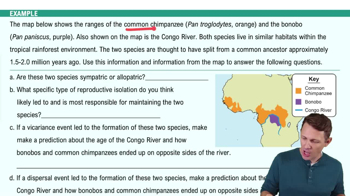
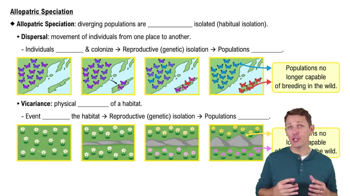
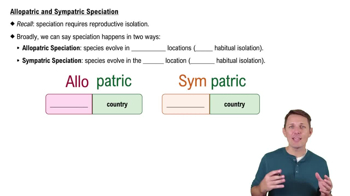
How do dispersal and vicariance contribute to allopatric speciation, and what are the evolutionary implications of each?
Dispersal involves a subset of a population moving to a new habitat, leading to genetic isolation and often a founder effect due to reduced genetic diversity. Vicariance occurs when a physical barrier splits a population, resulting in two large, isolated groups. Both lead to reproductive isolation and divergence, but dispersal often involves smaller populations and adaptation to new environments, while vicariance typically affects larger populations that remain in their original habitats.
 Back
Back
 02:46
02:46