Skip to main content
General Biology
My Course
Learn
Exam Prep
AI Tutor
Study Guides
Textbook Solutions
Flashcards
Explore
Try the app
My Course
Learn
Exam Prep
AI Tutor
Study Guides
Textbook Solutions
Flashcards
Explore
Try the app
Back
Aminotes exam
You can tap to flip the card.
Endothermic
You can tap to flip the card.
👆
Endothermic
Organisms that maintain a constant body temperature through internal metabolic processes.
Track progress
Control buttons has been changed to "navigation" mode.
1/30
Related flashcards
Related practice
Recommended videos
Aminotes quiz #1
Aminotes
24 Terms
Aminotes definitions
Aminotes
14 Terms
Aminotes quiz #2
Aminotes
10 Terms
Aminotes
32. Vertebrates
3 problems
Topic
Jason
Primates and Homonids
32. Vertebrates
7 problems
Topic
Jason
32. Vertebrates
3 topics
7 problems
Chapter
Jason
04:14
Birds and Synapsids
2785
views
9
rank
02:12
Marsupials and Placental Mammals
3229
views
15
rank
02:40
Mammals and Monotremes
2913
views
16
rank
Terms in this set (30)
Hide definitions
Endothermic
Organisms that maintain a constant body temperature through internal metabolic processes.
What are the three types of mammals?
Monotremes, marsupials, and placental mammals.
Chorion
The outermost membrane surrounding an embryo in an amniotic egg.
What is the function of the amnion?
It is a fluid-filled cavity that encases and protects the embryo.
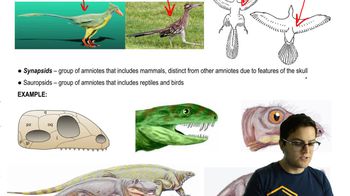
Synapsids
A group of amniotes that includes mammals, characterized by certain skull features.
What distinguishes placental mammals from other mammals?
They have a placenta that facilitates nutrient exchange between the mother and developing fetus.
Keratin
A protein found in the scales of reptiles, as well as in human hair and nails.
What is the role of the yolk sac?
It provides food for the embryo and is connected to the gut by blood vessels.
Monotremes
Egg-laying mammals, such as the platypus and echidna.
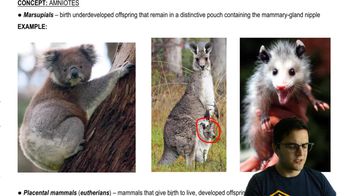
What are marsupials known for?
They birth underdeveloped offspring that continue to develop in a pouch.
Albumin
The protein-rich solution in an egg, commonly known as egg whites.
What is the function of the allantois?
It acts as a waste storage area for the embryo.
Neocortex
A part of the brain in mammals that allows for improved cognition.
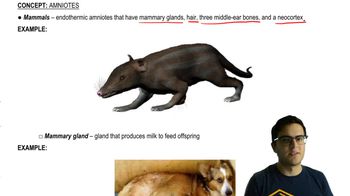
What are the defining features of mammals?
Hair, mammary glands, and three middle ear bones.
Sauropsids
A group of amniotes that includes reptiles and birds.
What is the significance of feathers in birds?
Feathers are a key adaptation for flight and insulation.
Placenta
An organ that connects the developing fetus to the uterus wall for nutrient exchange.
What is the evolutionary significance of reptiles?
They are the earliest living relatives of amniotes and have adaptations for life on land.
Mammary glands
Glands in mammals that produce milk to feed offspring.
What are the characteristics of endothermic vertebrates?
They maintain a constant body temperature and have features like feathers or hair.
Amniotes
A group of tetrapods that includes reptiles, birds, and mammals, characterized by having an amniotic egg.
What is the role of the shell in an amniotic egg?
It provides a protective outer layer for the embryo.
Ectothermic
Organisms that rely on external sources of heat to regulate their body temperature.
What are the main components of milk produced by mammary glands?
Water, fat, and sugar.
Lightweight skeletons
A characteristic of birds that aids in flight.
What is the evolutionary relationship between birds and dinosaurs?
Birds are classified as modern dinosaurs within the monophyletic group of reptiles.
Internal fertilization
A reproductive process where fertilization occurs inside the body, common in reptiles.
What is the function of the neocortex in mammals?
It allows for improved cognition and complex behaviors.
Marsupials
Mammals that birth underdeveloped offspring which continue to develop in a pouch.
What is the significance of the three middle ear bones in mammals?
They are used to convey sound and are a defining feature of mammals.
 BackBack
 04:14
04:14