Cancer cells exhibit uncontrolled cell division, lack of differentiation, and the ability to invade other tissues, unlike normal cells which have regulated growth and specific functions.
What is the difference between normal cell division and cancer cell division?
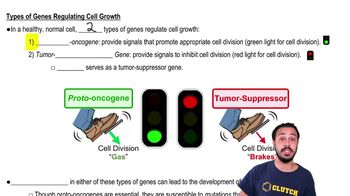
Normal cell division is tightly regulated by proto-oncogenes and tumor suppressor genes, while cancer cell division is unregulated due to mutations in these genes.
Is cancer contagious?
No, cancer is not contagious. It is caused by genetic mutations and environmental factors, not by infectious agents.
How does p53 prevent cancer cells from forming?
p53 is a tumor suppressor protein that can initiate apoptosis in damaged cells, preventing them from becoming cancerous.
What is metastasis?
Metastasis is the process by which cancer cells spread from the original tumor site to other parts of the body.
What is true of all cancers?
All cancers are characterized by uncontrolled cell division and the potential to invade other tissues.
What information could cancer researchers gain from using DNA microarrays?
DNA microarrays can help researchers identify gene expression patterns and mutations associated with cancer.
What are ways to differentiate between cancer cells and normal cells?
All of the above: Rate of division, Ability to metastasize, Chromosomal stability.
What is cancer?
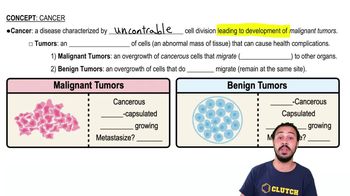
Cancer is a disease characterized by uncontrolled cell division leading to the formation of malignant tumors.
What is the difference between a malignant tumor and a benign tumor?
Malignant tumors are cancerous and can metastasize, while benign tumors are noncancerous and remain localized.
What are the typical functions of proteins encoded by genes that may become oncogenes?
These proteins typically promote cell division and growth.
Which noncommunicable disease is characterized by the uncontrolled growth of abnormal cells?
Cancer
What is most likely to occur when a tumor-suppressor gene is mutated?
Increased cell division
How do benign and malignant tumors differ?
Benign tumors are noncancerous and do not spread, while malignant tumors are cancerous and can metastasize.
What are characteristics of cancer cells?
Uncontrolled growth, Ability to invade other tissues, Resistance to apoptosis.
What is false about oncogenes?
Oncogenes inhibit cell division
How could loss of chromosomes result in cancer?
Loss of chromosomes can lead to the loss of tumor suppressor genes, resulting in uncontrolled cell division.
What can normal cells do that cancer cells cannot?
Normal cells can undergo apoptosis and have regulated cell division, unlike cancer cells.
What is not true about cancer cells?
They have regulated growth
What are characteristics of cancer cells?
Cancer cells have uncontrolled growth, the ability to invade other tissues, and often have genetic mutations.
How do changes to the cell cycle lead to cancer?
Both mutations in proto-oncogenes and mutations in tumor suppressor genes.
Evaluate each of the following defects. Which could lead to uncontrolled growth in cancer? A) Loss of tumor suppressor gene function B) Activation of oncogenes C) Both A and B D) Neither A nor B
C) Both A and B
Epigenetic disruptions of which part of the human genome may be involved in many cancers?
Epigenetic disruptions of tumor suppressor genes and proto-oncogenes may be involved in many cancers.
P53 is a protein that can initiate apoptosis in a damaged cell. What is apoptosis?
Apoptosis is the process of programmed cell death.
Which of these could lead to the conversion of a proto-oncogene into an oncogene? A) Gene amplification B) Point mutation C) Chromosomal translocation D) All of the above
D) All of the above
Which of the choices could be a proto-oncogene? A) A gene that promotes cell division B) A gene that inhibits cell division C) A gene that repairs DNA D) A gene that induces apoptosis
A) A gene that promotes cell division
How are the chromosomes different in the cancer cells compared to normal cells?
Cancer cells often have chromosomal abnormalities such as aneuploidy or structural rearrangements.
What results from uncontrolled mitosis?
Uncontrolled mitosis can lead to the formation of tumors and cancer.
What is the main difference between cancer cells and normal cells?
The main difference is that cancer cells have uncontrolled growth and division, while normal cells have regulated growth.
What is the role of genetics in the risk of developing cancer?
Some cancers have a genetic component
How is HeLa a call for us to do better with regard to ethical issues in science?
HeLa cells highlight the importance of informed consent and ethical considerations in scientific research.
What is the relationship between proto-oncogenes and oncogenes?
Proto-oncogenes are normal genes that promote cell division, while oncogenes are mutated versions that lead to uncontrolled growth.
What is a characteristic that cancer cells typically do not have?
High differentiation
How do we know that malignant tumors arise from a single cell that contains mutations?
Genetic analysis shows that all cells in a malignant tumor share the same mutations, indicating a single cell origin.
What is the normal role of the RB gene in cells?
The RB gene is a tumor suppressor that regulates the cell cycle and prevents uncontrolled cell division.
What causes cancer at the genetic level?
Cancer is caused by genetic mutations
What features distinguish cancer cells from normal cells?
All of the above
What disease can develop if a cell loses control of its cell division?
Cancer can develop if a cell loses control of its cell division.
What is a leading cause of death in the United States related to disease?
 Back
Back
 04:02
04:02