Skip to main content
General Biology
My Course
Learn
Exam Prep
AI Tutor
Study Guides
Textbook Solutions
Flashcards
Explore
Try the app
My Course
Learn
Exam Prep
AI Tutor
Study Guides
Textbook Solutions
Flashcards
Explore
Try the app
Back
Cancer quiz #3
You can tap to flip the card.
When cells become cancerous, what changes occur?
You can tap to flip the card.
👆
When cells become cancerous, what changes occur?
Cells exhibit uncontrolled growth, loss of differentiation, and the ability to invade other tissues.
Track progress
Control buttons has been changed to "navigation" mode.
1/33
Related flashcards
Related practice
Recommended videos
Cancer definitions
Cancer
12 Terms
Cancer quiz #1
Cancer
23 Terms
Cancer exam
Cancer
27 Terms
Cancer
11. Cell Division
6 problems
Topic
Jason
Review of the Cell Cycle
11. Cell Division
4 problems
Topic
11. Cell Division - Part 1 of 2
5 topics
9 problems
Chapter
Jason
11. Cell Division - Part 2 of 2
4 topics
9 problems
Chapter
Jason
Guided course
04:02
Types of Genes Regulating Cell Growth
9472
views
90
rank
1
comments
Guided course
03:22
Cancer
10592
views
129
rank
1
comments
Terms in this set (33)
Hide definitions
When cells become cancerous, what changes occur?
Cells exhibit uncontrolled growth, loss of differentiation, and the ability to invade other tissues.
What is the normal function of the p53 gene product?
The p53 gene product is a tumor suppressor that can initiate apoptosis in response to DNA damage.
How do mutations relate to the development of cancer?
Mutations in specific genes can lead to cancer
In which cellular process are the cancer-causing forms of the RAS protein involved?
Cell division
How is cancer cell growth different from normal cell growth?
Cancer cell growth is unregulated and can lead to tumor formation, while normal cell growth is controlled and regulated.
Which protein is considered a tumor suppressor because it can initiate apoptosis?
A) p53, because it can initiate apoptosis
What is cancer and how is it characterized at the cellular level?
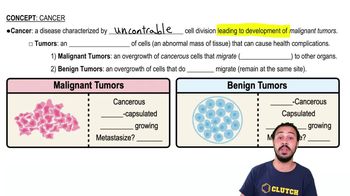
Cancer is a disease characterized by uncontrolled cell division, leading to the formation of tumors.
What are the two main types of tumors?
The two main types of tumors are malignant tumors and benign tumors.
What does it mean for a tumor to metastasize?
Metastasize means to spread from the original site to other organs in the body.
Do benign tumors metastasize?
No, benign tumors do not metastasize; they remain localized.
What is the role of a capsule in benign tumors?
A capsule surrounds benign tumors, helping to contain them and prevent their spread.
What are proto-oncogenes?
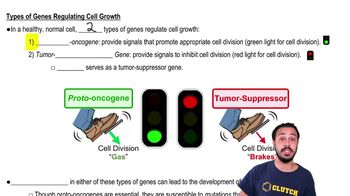
Proto-oncogenes are normal genes that promote appropriate cell division.
What are tumor suppressor genes?
Tumor suppressor genes are genes that inhibit cell division, acting as a 'red light' to prevent uncontrolled growth.
What is an example of a tumor suppressor gene?
p53 is an example of a tumor suppressor gene.
What is an oncogene?
An oncogene is a mutated proto-oncogene that promotes uncontrolled cell division, contributing to cancer development.
Why is the balance between proto-oncogenes and tumor suppressor genes important?
The balance ensures that cell division occurs only when needed and is properly regulated, preventing uncontrolled growth.
How do healthy cells prevent the development of cancer?
Healthy cells use proto-oncogenes to promote and tumor suppressor genes to inhibit cell division, maintaining proper control.
What happens when both proto-oncogenes and tumor suppressor genes are mutated?
Mutations in both can lead to loss of cell cycle control and increase the risk of cancer.
What is the primary characteristic of cancer cells compared to normal cells?
Cancer cells divide uncontrollably, ignoring normal regulatory signals.
Can benign tumors cause health complications?
Yes, benign tumors can cause health issues, but they are generally less dangerous than malignant tumors.
What is the significance of a tumor being capsulated?
Capsulated tumors, like benign tumors, are contained and less likely to spread.
How do mutations in cell cycle regulatory genes lead to cancer?
Mutations can disrupt normal regulation, causing uncontrolled cell division and tumor formation.
Why is understanding proto-oncogenes and tumor suppressor genes important in cancer biology?
Because they are key regulators of cell division, and their mutations are central to cancer development.
What does it mean for a gene to act as a 'red light' in cell division?
It inhibits cell division, as tumor suppressor genes do.
What is the consequence of unrestrained cell growth?
Unrestrained cell growth can lead to cancer and tumor formation.
How do normal cells maintain control over cell division?
By balancing the activity of proto-oncogenes and tumor suppressor genes.
Why are malignant tumors often more life-threatening than benign tumors?
Because they can invade other tissues and organs, spreading cancer throughout the body.
How can a single mutation in a proto-oncogene contribute to cancer?
It can convert the proto-oncogene into an oncogene, leading to unregulated cell division.
What is the significance of cell cycle regulation in cancer prevention?
Proper regulation prevents uncontrolled cell growth and tumor formation.
What is the role of genetic mutations in the transformation of normal cells into cancer cells?
Genetic mutations disrupt normal regulatory mechanisms, leading to cancer.
What is the main danger of metastasis in cancer progression?
Metastasis allows cancer to spread to vital organs, making it harder to treat and more deadly.
What is the impact of multiple mutations in cell cycle regulatory genes?
Multiple mutations greatly increase the risk of uncontrolled cell growth and cancer.
What is the ultimate consequence of unchecked cell division in the body?
Unchecked cell division leads to tumor formation and the development of cancer.
 BackBack
 04:02
04:02