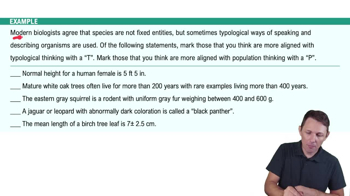
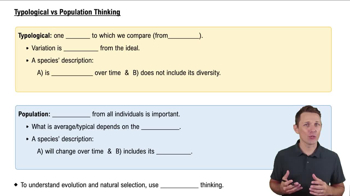
How does population thinking change our understanding of species?
It emphasizes the importance of variation and diversity within species, rather than focusing on a single ideal form.
What is the relationship between natural selection and adaptation?
Natural selection leads to adaptation by favoring traits that improve survival and reproduction.
Why is it important to use tree thinking when interpreting evolutionary relationships?
Tree thinking accurately reflects the branching patterns of evolution and common ancestry among species.
What does 'descent with modification' mean in the context of evolution?
'Descent with modification' means that species change over generations, inheriting traits from ancestors but also accumulating differences over time.
How does natural selection cause evolution in a population?
Natural selection causes evolution by favoring traits that help individuals survive and reproduce, making those traits more common in future generations.
What is the scientific meaning of 'fitness' in evolutionary biology?
In evolutionary biology, 'fitness' refers to an individual's likelihood of contributing offspring to the next generation, not just physical strength or health.
How does population thinking differ from typological thinking when defining a species?
Population thinking emphasizes the importance of variation and diversity within a species, while typological thinking focuses on a single ideal form and treats variation as deviation.
Why is variation within a population important for evolution and natural selection?
Variation provides the raw material for natural selection to act upon, allowing populations to adapt to changing environments over time.
What is the main difference between ladder thinking and tree thinking in understanding species relationships?
Ladder thinking arranges species in a hierarchy of complexity, while tree thinking focuses on evolutionary relationships and common ancestry without ranking species.
How do phylogenetic trees help us understand evolutionary relationships among species?
Phylogenetic trees illustrate how species are related through common ancestors, showing branching patterns that reflect evolutionary history rather than a hierarchy.
How can evolution be best defined in biology?
Evolution can be best defined as the gradual change of populations over time, described as 'descent with modification,' where species share common ancestors and accumulate changes across generations.
What is biological evolution?
Biological evolution is the process by which populations of organisms change over time through descent with modification, meaning that species share common ancestors and accumulate differences as they are passed down through generations.
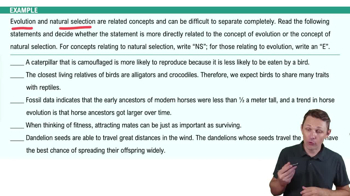
What is the relationship between evolution and natural selection?
Natural selection is a key mechanism of evolution. It favors traits that enhance survival and reproduction, causing those traits to become more common in a population over time, which leads to evolutionary change.
 Back
Back
 03:22
03:22