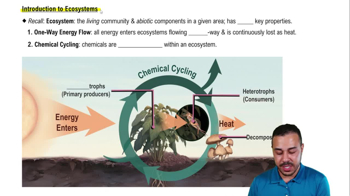
An ecosystem consists of communities of organisms and their environments, including both biotic and abiotic components, where energy flows and matter cycles.
How do nutrients move through an ecosystem?
Nutrients are recycled within an ecosystem.
What makes up an ecosystem?
An ecosystem is made up of living communities (biotic factors) and non-living components (abiotic factors) in a given area.
How do nutrients move through an ecosystem?
Nutrients move through an ecosystem by being recycled through various trophic levels, involving processes like decomposition and biogeochemical cycles.
How is an ecosystem best described?
A community of organisms interacting with their physical environment.
What is the relationship between energy and matter in an ecosystem?
Energy flows and matter cycles.
What is an example of an ecosystem?
A forest.
In an ecosystem, what is the role of decomposers?
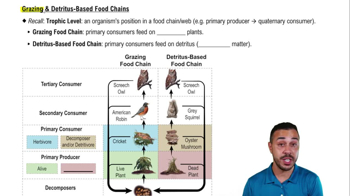
Decomposers break down dead organic matter and waste, recycling nutrients back into the ecosystem.
What term includes all the biotic and abiotic factors in an area? A) Ecosystem B) Population C) Community D) Organ
A) Ecosystem
How does energy flow in ecosystems?
Energy flows in one direction through ecosystems.
What features are present at the ecosystem level?
Both biotic and abiotic factors.
How do ecosystems recycle nutrients?
They recycle nutrients through decomposition.
What would happen in an ecosystem without decomposers?
Without decomposers, dead organic matter and waste would accumulate, disrupting nutrient cycling and ecosystem balance.
What is an example of an ecosystem?
A lake.
Which choice is not an example of an ecosystem? A) A desert. B) A coral reef. C) A single organism. D) A rainforest.
C) A single organism.
What are the two key properties of ecosystems, and how do they differ in terms of energy and chemical movement?
The two key properties of ecosystems are one-way energy flow and chemical cycling. Energy flows in one direction through the ecosystem and is lost as heat at each transfer, requiring a constant input (usually from the sun). In contrast, chemicals are recycled within the ecosystem, moving between organisms and the environment through processes like decomposition.
Why are decomposers essential in ecosystems, and what environmental factors influence the rate of decomposition?
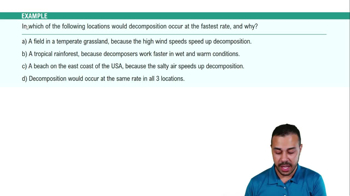
Decomposers are essential because they break down dead organic matter and waste, recycling nutrients back into the ecosystem. The rate of decomposition increases with higher temperature, moisture, and oxygen levels, making decomposition fastest in warm, moist, and oxygen-rich environments.
 Back
Back
 03:29
03:29