Pearson+ LogoPearson+ Logo

Introduction to Ecosystems quiz #3 Flashcards

Back
Introduction to Ecosystems quiz #3
Control buttons has been changed to "navigation" mode.
1/32
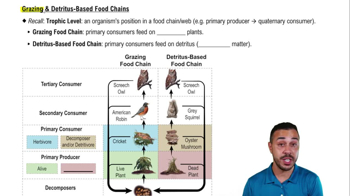
  • How do grazing food chains differ from detritus-based food chains in terms of primary producers and consumers?

    In grazing food chains, primary producers are living plants and primary consumers are herbivores that eat these plants. In detritus-based food chains, the primary 'producers' are dead organic matter (detritus), and the primary consumers are decomposers or detritivores that feed on this detritus.
  • What are the two main components of an ecosystem?

    The two main components of an ecosystem are the living community (biotic factors) and the abiotic components (non-living factors) in a given area.
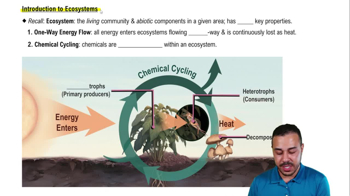
  • How does energy flow through an ecosystem?

    Energy flows in one direction through an ecosystem, entering primarily from the sun and being lost as heat at each transfer between trophic levels.
  • How is chemical cycling in ecosystems different from energy flow?

    Unlike energy, which flows one way and is lost as heat, chemicals are recycled within ecosystems through processes involving producers, consumers, and decomposers.
  • What is the role of autotrophs in an ecosystem?

    Autotrophs, also called primary producers, capture energy from the sun (or other sources) and produce their own nutrients through processes like photosynthesis.
  • Who are the primary consumers in a grazing food chain, and what do they eat?

    Primary consumers in a grazing food chain are herbivores that eat living plants (the primary producers).
  • In a detritus-based food chain, what serves as the primary 'producer' and who are the primary consumers?

    In a detritus-based food chain, dead organic matter (detritus) serves as the primary 'producer,' and decomposers or detritivores are the primary consumers.
  • What is the ecological role of decomposers in an ecosystem?

    Decomposers break down dead organic matter and waste, recycling nutrients back into the ecosystem and completing the chemical cycle.
  • How can a single organism participate in multiple food chains or trophic levels?

    A single organism can participate in both grazing and detritus-based food chains and may occupy different trophic levels in different food chains.
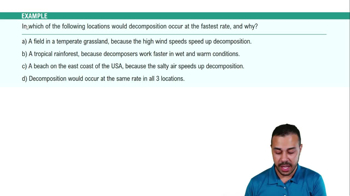
  • Which environmental factors increase the rate of decomposition in ecosystems?

    Decomposition rates increase with higher temperature, moisture, and oxygen levels, which is why they are greatest near the equator.
  • What is an ecosystem comprised of?

    An ecosystem is comprised of both living communities of organisms (biotic components) and non-living environmental factors (abiotic components) in a given area.
  • What size can an ecosystem be?

    An ecosystem can range in size from a tiny puddle under a rock to thousands of miles in area, encompassing a wide variety of organisms and environments.
  • What does an ecosystem consist of?

    An ecosystem consists of communities of organisms and their physical environment, including both biotic and abiotic factors.
  • How is a habitat different from an ecosystem?

    A habitat is the specific place where an organism lives, while an ecosystem includes all the living organisms and their interactions with the abiotic environment in a given area.
  • Give an example of an ecosystem.

    Examples of ecosystems include a forest, a pond, a coral reef, or even a small puddle under a rock.
  • What is a biotic factor in an ecosystem?

    A biotic factor in an ecosystem is any living component, such as plants, animals, fungi, or bacteria.
  • What are the four categories of ecosystem services?

    The four categories of ecosystem services are provisioning, regulating, supporting, and cultural services.
  • What is the role a species plays in an ecosystem called?

    The role a species plays in an ecosystem is called its ecological niche.
  • What is the difference between a community and an ecosystem?

    A community consists of all the living organisms in an area, while an ecosystem includes both the community and the abiotic environment.
  • What is a producer in an ecosystem?

    A producer in an ecosystem is an organism, such as a plant or algae, that can make its own food using energy from the sun or other sources.
  • What are the four types of ecosystem services?

    The four types of ecosystem services are provisioning, regulating, supporting, and cultural services.
  • What are the components of an ecosystem?

    The components of an ecosystem include biotic factors (living organisms) and abiotic factors (non-living environmental elements such as water, soil, and climate).
  • What are the different components of an ecosystem?

    The different components of an ecosystem are biotic components (plants, animals, fungi, bacteria) and abiotic components (water, air, soil, temperature, sunlight).
  • Can an ecosystem survive with only producers?

    No, an ecosystem cannot survive with only producers because consumers and decomposers are needed to cycle nutrients and maintain energy flow.
  • Which items are abiotic factors of an ecosystem?

    Abiotic factors of an ecosystem include non-living elements such as sunlight, temperature, water, soil, and air.
  • What is an example of an abiotic change in an ecosystem?

    An example of an abiotic change in an ecosystem is a change in temperature, moisture, or oxygen levels.
  • How would you best describe an ecosystem?

    An ecosystem is a system that includes all living organisms in a given area and their interactions with the non-living environment.
  • Which ecosystem services do dung beetles provide?

    Dung beetles provide supporting and regulating ecosystem services by recycling nutrients and aiding in decomposition.
  • Why are decomposers so critical in an ecosystem?

    Decomposers are critical in an ecosystem because they break down dead organic matter and waste, recycling nutrients back into the environment for use by producers.
  • What is the main source of energy for most ecosystems?

    The main source of energy for most ecosystems is the sun.
  • What is the difference between a grazing food chain and a detritus-based food chain?

    A grazing food chain starts with live plants consumed by herbivores, while a detritus-based food chain starts with dead organic matter consumed by decomposers or detritivores.
  • What factors increase the rate of decomposition in an ecosystem?

    The rate of decomposition increases with higher temperature, moisture, and oxygen levels.