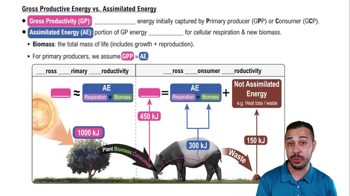
How does gross consumer productivity (GCP) differ from gross primary productivity (GPP)?
Gross consumer productivity (GCP) is the total energy captured by consumers from consuming biomass, while GPP is the energy captured by primary producers from sunlight.
How is net productivity (NP) calculated in an ecosystem?
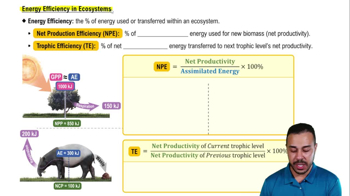
Net productivity (NP) is calculated as assimilated energy (AE) minus the energy used for respiration (R): NP = AE - R.
What is net consumer productivity (NCP) or net secondary productivity?
Net consumer productivity (NCP) is the amount of assimilated energy in consumers that is converted into new biomass after subtracting energy used for respiration.
What is the significance of net productivity for the next trophic level?
Net productivity represents the total energy available to be consumed by the next trophic level in the food chain.
How do you calculate net production efficiency (NPE)?
NPE is calculated by dividing net productivity by assimilated energy and multiplying by 100%: NPE = (Net Productivity / Assimilated Energy) × 100%.
What is trophic efficiency (TE) in an ecosystem?
Trophic efficiency (TE) is the percentage of energy at one trophic level that is transferred to the next trophic level as new biomass.
Why is trophic efficiency typically low in ecosystems?
Trophic efficiency is typically low (around 10%) because much energy is lost as heat, waste, and through respiration at each trophic level.
Why can NPE be calculated for every trophic level, but TE only across trophic levels?
NPE is specific to each organism or trophic level, while TE compares energy transfer between two adjacent trophic levels.
How does energy flow through an ecosystem from the sun to higher trophic levels?
Energy flows from the sun to primary producers (GPP), then to consumers (GCP), with losses at each step due to waste, heat, and respiration.
How does the production of new biomass relate to net productivity?
Net productivity is the energy available for the production of new biomass through growth and reproduction.
What is meant by the term 'biomass' in the context of energy flow?
Biomass refers to the total mass of living organisms or the mass of new tissue produced by growth and reproduction.
What is the typical value for trophic efficiency in most ecosystems?
Trophic efficiency in most ecosystems is typically around 10%.
What is the relationship between net productivity and the energy available to consumers?
Net productivity of a trophic level determines the amount of energy available to consumers at the next trophic level.
What is the fate of energy that is not converted into biomass at each trophic level?
Energy not converted into biomass is lost as heat or waste, primarily through respiration and excretion.
Why is it important to understand energy flow through ecosystems?
Understanding energy flow helps explain the structure of food webs, limits on trophic levels, and the efficiency of energy transfer in ecosystems.
What is the main source of energy for primary producers?
The main source of energy for primary producers is sunlight.
How does the loss of energy at each trophic level affect the length of food chains?
Energy loss at each trophic level limits the number of trophic levels, resulting in shorter food chains.
What is the difference between gross and net productivity?
Gross productivity is the total energy captured, while net productivity is the energy remaining after subtracting respiration losses.
How do you determine the amount of energy available to a secondary consumer?
The energy available to a secondary consumer is determined by the net productivity of the primary consumer it eats.
Why do ecosystems with higher NPP support more consumers?
Higher NPP means more energy is available for consumers, supporting larger populations and more trophic levels.
What is the relationship between GPP, respiration, and NPP in primary producers?
NPP is equal to GPP minus the energy used for respiration: NPP = GPP - R.
How does waste production by consumers affect energy flow?
Waste production by consumers reduces the amount of assimilated energy, decreasing the energy available for biomass and transfer to higher trophic levels.
What is the significance of the 10% rule in energy transfer?
The 10% rule states that only about 10% of the energy at one trophic level is transferred to the next, limiting ecosystem productivity.
How can energy flow concepts be applied to ecosystem management?
Understanding energy flow helps manage ecosystems by predicting productivity, sustainability, and the impact of changes in trophic structure.
What factors can cause variation in NPE among different organisms?
Variation in NPE is caused by differences in metabolic rates, activity levels, and environmental conditions.
How does energy flow through a simple food chain?
Energy flows from the sun to producers, then to primary consumers, and then to higher-level consumers, with energy lost at each step.
Why is energy flow in ecosystems considered unidirectional?
Energy flow is unidirectional because energy enters as sunlight and is eventually lost as heat, not recycled within the ecosystem.
What limits the number of trophic levels in an ecosystem?
The loss of energy at each trophic level limits the number of trophic levels that can be supported in an ecosystem.
How does the efficiency of energy transfer impact ecosystem structure?
Low energy transfer efficiency restricts the number of trophic levels and the biomass of higher-level consumers.
Why are producers so important to an ecosystem?
Producers are important because they capture energy from sunlight and convert it into biomass, providing the primary source of energy for all other organisms in the ecosystem.
Why is sunlight important in an ecosystem?
Sunlight is important because it is the initial energy source for producers, enabling photosynthesis and driving energy flow through the ecosystem.
What is true about energy in an ecosystem?
Energy in an ecosystem flows from producers to consumers and is gradually lost as heat and waste at each trophic level.
Why are producers an essential component of an ecosystem?
Producers are essential because they convert solar energy into chemical energy, forming the base of the food web and supporting all other trophic levels.
How does energy first enter a pond ecosystem?
Energy first enters a pond ecosystem through sunlight, which is captured by producers such as aquatic plants and algae.
What role do plants play in an ecosystem?
Plants act as producers, capturing energy from sunlight and converting it into biomass that supports consumers and other organisms.
What is the role of producers in an ecosystem?
Producers capture and convert energy from sunlight into biomass, providing energy and organic matter for consumers and decomposers.
What are producers in an ecosystem?
Producers are organisms, such as plants and algae, that capture energy from sunlight and convert it into chemical energy through photosynthesis.
What is the role of the producer in an ecosystem?
The role of the producer is to convert solar energy into biomass, forming the foundation of the food web and supplying energy to other trophic levels.
Energy in an ecosystem flows directly from what to what?
Energy in an ecosystem flows directly from the sun to producers, and then from producers to consumers.
What role do decomposers play in an ecosystem?
Decomposers break down dead organic matter and waste, recycling nutrients and returning them to the ecosystem for use by producers.
 Back
Back
 05:28
05:28