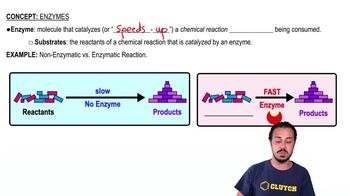
Enzymes are biological catalysts that speed up chemical reactions without being consumed in the process.
What is the function of an enzyme?
The function of an enzyme is to catalyze or speed up chemical reactions in biological systems.
What explains the reaction specificity of an enzyme?
Enzymes have a specific active site that binds to specific substrates.
What is the function of enzymes in biological systems?
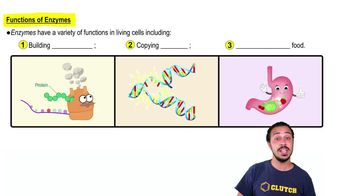
Enzymes function as catalysts to accelerate chemical reactions, aiding in processes like protein synthesis, DNA replication, and digestion.
What is an enzyme's role in a cell?
An enzyme's role in a cell is to facilitate and speed up biochemical reactions necessary for cellular functions.
What is the function of the active site of an enzyme?
It is where substrates bind and reactions are catalyzed.
How do enzymes bind to substrates?
Enzymes bind to substrates at their active site, forming an enzyme-substrate complex that facilitates the reaction.
How does the shape of an enzyme affect its function?
The shape of an enzyme determines its specificity and ability to bind to its substrate, affecting its catalytic activity.
What enzyme is responsible for splitting the two strands of DNA during replication?
Helicase is the enzyme responsible for unwinding and splitting the two strands of DNA during replication.
What happens to an enzyme when the temperature or pH of its environment changes?
Changes in temperature or pH can denature an enzyme, altering its shape and reducing its activity.
What happens to an enzyme after a biochemical reaction?
After a biochemical reaction, an enzyme remains unchanged and can catalyze additional reactions.
What is the likely effect of disrupting the active site of an enzyme?
Decreased enzyme activity.
What role do enzymes play in the human body?
Enzymes catalyze biochemical reactions, aiding in processes such as digestion, metabolism, and DNA replication.
What does the activity of an enzyme describe?
The activity of an enzyme is the rate at which it converts substrates into products under specific conditions.
Why is the secondary antibody used in an ELISA test conjugated with an enzyme?
The secondary antibody is conjugated with an enzyme to produce a detectable signal, indicating the presence of the target antigen.
What kind of enzyme removes a phosphate group from a protein?
A phosphatase is an enzyme that removes a phosphate group from a protein.
What is the active site of an enzyme?
The active site of an enzyme is the region where substrate molecules bind and undergo a chemical reaction.
What is the active site of an enzyme?
The active site is the specific region of an enzyme where substrates bind and catalysis occurs.
What are characteristics of allosteric enzymes?
Allosteric enzymes have multiple binding sites and can be regulated by molecules that bind to sites other than the active site.
Which type of protein facilitates all chemical reactions of a cell?
Enzymes are the type of proteins that facilitate all chemical reactions in a cell.
What binds to the active site of an enzyme?
The substrate binds to the active site of an enzyme.
How does an enzyme influence a biological reaction?
An enzyme lowers the activation energy of a reaction, increasing the reaction rate.
Why is the active site of an enzyme important to enzyme activity?
The active site is crucial because it is where the substrate binds and the reaction is catalyzed.
How is the nucleus involved in the production of enzymes?
The nucleus contains DNA, which encodes the genetic information for synthesizing enzymes.
How would a change in the enzyme's structure alter its function?
A change in an enzyme's structure can alter its active site, affecting substrate binding and catalytic activity.
In order for the reaction to take place with an enzyme, what must occur?
The substrate must bind to the enzyme's active site to form an enzyme-substrate complex.
Why are enzymes so critical to cell functioning?
Enzymes are critical because they catalyze essential biochemical reactions at rates necessary for life.
How are enzymes useful within organisms?
Enzymes facilitate and speed up metabolic processes, enabling efficient cellular function and homeostasis.
Which best explains how the structure of enzymes is related to their function?
The specific three-dimensional structure of enzymes determines their ability to bind substrates and catalyze reactions.
How does the structure of an enzyme affect its function?
The structure of an enzyme determines the shape of its active site, which is critical for substrate binding and catalysis.
What does a kinase do?
A kinase is an enzyme that adds a phosphate group to a molecule, often a protein.
What factors influence the rate at which enzymes function?
Temperature, pH, and substrate concentration influence the rate at which enzymes function.
How are receptor proteins and enzymes similar?
Both receptor proteins and enzymes have specific binding sites for their respective ligands or substrates.
Which three of the following are characteristics of most enzymes? A) Specificity. B) Reusability. C) Being consumed in reactions. D) Sensitivity to environmental conditions.
A) Specificity. B) Reusability. D) Sensitivity to environmental conditions.
What is the function of membrane proteins that are enzymes?
Membrane proteins that are enzymes catalyze reactions at the cell membrane, aiding in processes like signal transduction and transport.
Which enzyme relaxes the supercoils in the DNA helix?
Topoisomerase is the enzyme that relaxes supercoils in the DNA helix.
Without enzymes, what would happen to biological reactions?
Without enzymes, biological reactions would occur too slowly to sustain life.
What is the structure of an enzyme?
Enzymes are typically globular proteins with a specific three-dimensional shape that includes an active site.
What would happen if organisms did not have enzymes?
Without enzymes, organisms would not be able to carry out essential biochemical reactions efficiently, leading to a failure in sustaining life.
 Back
Back

 02:32
02:32