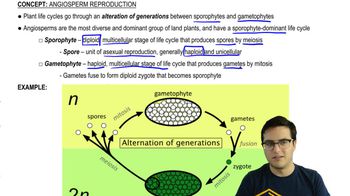
A life cycle in which there is both a multicellular diploid form, the sporophyte, and a multicellular haploid form, the gametophyte.
What is the dominant generation in angiosperms?
Sporophyte
Sporophyte
The diploid, multicellular stage in the life cycle of a plant that produces haploid spores through meiosis.
Gametophyte
The haploid, multicellular stage in the life cycle of a plant that produces gametes through mitosis.
What are the two types of spores produced by angiosperms?
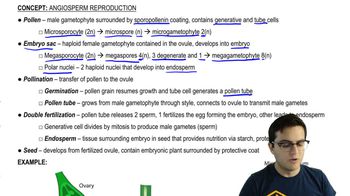
Microspores (male) and megaspores (female)
Double fertilization
A process in angiosperms where one sperm fertilizes the egg, forming a zygote, and the other sperm combines with two polar nuclei to form the endosperm.
What is the function of the endosperm?
To provide nutrients to the developing embryo.
Complete flower
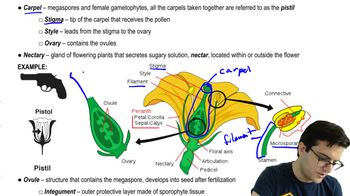
A flower that has all four basic floral organs: sepals, petals, stamens, and carpels.
Perfect flower
A flower that has both male (stamens) and female (carpels) reproductive structures.
What is vegetative reproduction?
A form of asexual reproduction in plants where new individuals are produced from the vegetative parts of the plant, such as stems, roots, or leaves.
Rhizomes
Underground stems that can produce new individual plants.
Stolons
Above-ground stems that can produce new individual plants.
What is apomixis?
The formation of seeds without fertilization, resulting in a clone of the parent plant.
Sepal
A leaf-like structure that encloses and protects the bud of a flower.
Calyx
The collective term for all the sepals of a flower.
Corolla
The collective term for all the petals of a flower.
Stamen
The male reproductive part of a flower, consisting of an anther and a filament.
Carpel
The female reproductive part of a flower, consisting of the stigma, style, and ovary.
What is the function of the stigma?
To receive pollen during pollination.
Nectary
A gland that secretes nectar, attracting pollinators.
What is the role of the pollen tube?
To transport sperm from the pollen grain to the ovule.
Embryo sac
The female gametophyte within the ovule of a flowering plant.
What is self-incompatibility?
A genetic mechanism in plants that prevents self-pollination and encourages cross-pollination.
Temporal separation
A mechanism to prevent self-pollination by having male and female gametophytes mature at different times.
Spatial avoidance
A mechanism to prevent self-pollination by spatially separating male and female floral organs.
Pollination syndrome
Traits in flowers that have evolved in response to specific pollinators.
Coevolution
The process by which two or more species influence each other's evolutionary pathway.
What is the main benefit of cross-pollination?
Increased genetic diversity.
Monoecious plants
Plants that have both male and female flowers on the same individual.
Dioecious plants
Plants that have male and female flowers on separate individuals.
 Back
Back
 04:08
04:08