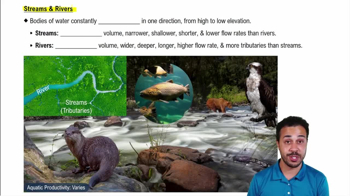
How do streams and rivers differ from each other, and what is the role of tributaries in these freshwater systems?
Streams are smaller, narrower, and have lower flow rates compared to rivers, which are larger, deeper, and have higher flow rates. Tributaries are smaller bodies of water, like streams, that flow into and contribute water to larger rivers.
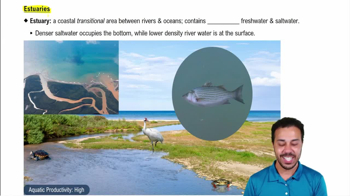
What is an estuary, and why are estuaries considered highly productive ecosystems?
An estuary is a coastal area where freshwater from rivers meets and mixes with saltwater from the ocean. Estuaries are highly productive because they support a wide variety of species adapted to fluctuating salinity levels and provide abundant nutrients.
What are the main differences between oligotrophic and eutrophic lakes?
Oligotrophic lakes are nutrient-poor but oxygen-rich with clear water, while eutrophic lakes are nutrient-rich but oxygen-poor with abundant plant and algae growth.
Why do eutrophic lakes often have low oxygen levels despite high plant and algae growth?
When abundant surface plants and algae die, they sink and decompose, a process that consumes oxygen and creates an oxygen-poor environment.
How can a lake change between being oligotrophic and eutrophic?
A lake can shift from oligotrophic to eutrophic or vice versa depending on changes in nutrient input and other environmental factors.
How do streams and rivers differ in terms of size and flow?
Streams are smaller, narrower, and have lower flow rates, while rivers are larger, deeper, wider, and have higher flow rates.
What is the role of tributaries in river systems?
Tributaries are smaller bodies of water, like streams, that flow into and contribute water to larger rivers.
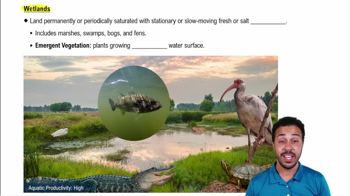
What are wetlands and what are the four main types?
Wetlands are land areas saturated with water either permanently or periodically, and the four main types are marshes, swamps, bogs, and fens.
What is a characteristic feature of all wetlands?
All wetlands have emergent vegetation, which are plants that grow above the water surface.
What makes estuaries highly productive ecosystems?
Estuaries support a wide variety of species adapted to fluctuating salinity levels and provide abundant nutrients, making them highly productive.
What are examples of freshwater ecosystems?
Examples of freshwater ecosystems include lakes (oligotrophic and eutrophic), streams, rivers, and wetlands such as marshes, swamps, bogs, and fens.
Which type of freshwater lake is least productive in terms of primary production?
Oligotrophic lakes are the least productive freshwater ecosystems because they are nutrient-poor and support fewer primary producers.
Which type of freshwater ecosystem is considered the most productive?
Wetlands are often considered the most productive freshwater ecosystems, as they typically support high aquatic productivity and diverse life.
What distinguishes estuaries from freshwater ecosystems?
Estuaries are not considered freshwater ecosystems because they are transitional areas where freshwater from rivers mixes with saltwater from the ocean, resulting in brackish water.
What are the main types of wetlands found in freshwater biomes?
The main types of wetlands in freshwater biomes are marshes, swamps, bogs, and fens.