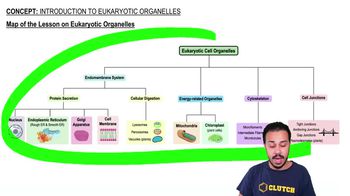
What evolutionary advantage does compartmentalization of core metabolic processes offer eukaryotes?
Compartmentalization allows for increased efficiency and specialization of cellular processes, enabling more complex metabolic pathways and regulation.
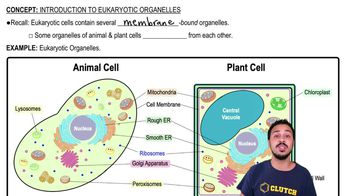
What structures are present in a plant cell?
Plant cells contain structures such as the cell wall, chloroplasts, central vacuole, nucleus, mitochondria, endoplasmic reticulum, Golgi apparatus, and ribosomes.
What is the function of the nucleolus?
The nucleolus is responsible for the production and assembly of ribosome components.
Which organelles are not found in plant cells?
Lysosomes are typically not found in plant cells.
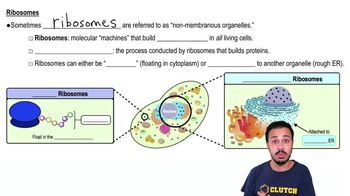
What is the function of ribosomes?
Ribosomes are responsible for protein synthesis through the process of translation.
Which organelle is labeled E? Options: Golgi apparatus, Chloroplast, Ribosome, Nucleus
The question is incomplete without a diagram, but typically, the nucleus is a large, central organelle, while ribosomes are small and scattered.
What is true about vacuoles?
Vacuoles are storage organelles that can hold various substances such as nutrients, waste products, and water.
What are histones?
Histones are proteins that help package and organize DNA into structural units called nucleosomes.
What is the function of the vacuole?
The vacuole stores nutrients, waste products, and helps maintain turgor pressure in plant cells.
Which part of the plant cell provides structural support and protection?
The cell wall provides structural support and protection for plant cells.
Which organelle is a fine network of tubular structures?
The endoplasmic reticulum is a fine network of tubular structures.
Which organelle is not found in an animal cell?
Chloroplasts are not found in animal cells.
What is the function of the ribosomes?
Ribosomes synthesize proteins by translating mRNA into polypeptide chains.
Which organisms are found in the domain Eukarya?
Organisms in the domain Eukarya include animals, plants, fungi, and protists.
What is the main function of the vacuole in a plant cell?
The main function of the vacuole in a plant cell is to store nutrients and waste products and maintain turgor pressure.
What do all organisms in the domain Eukarya have in common?
All organisms in the domain Eukarya have cells with a true nucleus and membrane-bound organelles.
What is the function of a lysosome?
Lysosomes digest and break down waste materials and cellular debris.
What is the function of a vacuole?
Vacuoles store nutrients, waste products, and help maintain turgor pressure in plant cells.
What organelle does the plant cell not have but the animal cell does have?
Plant cells typically do not have centrioles, which are found in animal cells.
Which organelle is not involved in protein synthesis?
Lysosome is not involved in protein synthesis.
What is the role of the nucleolus?
The nucleolus is involved in the production and assembly of ribosome components.
Which organelle is not found in a plant cell?
Lysosomes are typically not found in plant cells.
What cellular process occurs in the cytosol of a eukaryotic cell?
Glycolysis occurs in the cytosol of a eukaryotic cell.
What synapomorphy defines the Eukarya?
The presence of a true nucleus and membrane-bound organelles defines the Eukarya.
Which organelle is the recycling center of the cell?
Lysosomes act as the recycling center of the cell by breaking down waste materials.
What kind of organisms are multicellular? (Choose all that are correct)
Multicellular organisms include animals, plants, and some fungi.
Which of these processes occurs in the cytosol?
Glycolysis occurs in the cytosol.
Which organelle's structure and function are correctly described as ribosome - protein synthesis?
Ribosome - protein synthesis is correctly described.
Describe why eukaryotic cells being compartmentalized can make their metabolism more complex?
Compartmentalization allows for specialized environments and processes, increasing metabolic complexity and efficiency.
What is the jelly-like substance inside all cells?
The jelly-like substance inside all cells is called cytoplasm.
What are the functions of the central vacuole in plants?
The central vacuole stores nutrients, waste products, and helps maintain turgor pressure.
Which cell organelle is not found in a plant cell?
Lysosomes are typically not found in plant cells.
Which organelle is the site where amino acids are synthesized into proteins?
Ribosomes are the site where amino acids are synthesized into proteins.
What group of organisms were the first eukaryotes?
Protists are considered some of the first eukaryotes.
What is a similarity between cilia and flagella?
Both cilia and flagella are involved in cell movement and are composed of microtubules.
What do plant cells have that animal cells do not have?
Plant cells have a cell wall, chloroplasts, and a large central vacuole, which animal cells do not have.
What is the function of cilia?
Cilia are involved in movement and can help move fluid or materials past the cell surface.
What is the role of ribosomes?
Ribosomes synthesize proteins by translating mRNA into polypeptide chains.
What two organelles are involved in protein synthesis?
Ribosomes and the rough endoplasmic reticulum are involved in protein synthesis.
What do ribosomes do?
Ribosomes synthesize proteins by translating mRNA into polypeptide chains.
 Back
Back

 03:45
03:45