Skip to main content
General Biology
My Course
Learn
Exam Prep
AI Tutor
Study Guides
Textbook Solutions
Flashcards
Explore
Try the app
My Course
Learn
Exam Prep
AI Tutor
Study Guides
Textbook Solutions
Flashcards
Explore
Try the app
Back
Introduction to Prokaryotes definitions
You can tap to flip the card.
Prokaryote
You can tap to flip the card.
👆
Prokaryote
A cell type lacking a nucleus and membrane-bound organelles, found in domains Bacteria and Archaea.
Track progress
Control buttons has been changed to "navigation" mode.
1/15
Related flashcards
Related practice
Recommended videos
Introduction to Prokaryotes quiz #1
Introduction to Prokaryotes
1 Term
Introduction to Prokaryotes quiz #2
Introduction to Prokaryotes
38 Terms
Introduction to Prokaryotes quiz #3
Introduction to Prokaryotes
37 Terms
Introduction to Prokaryotes
26. Prokaryotes
5 problems
Topic
Prokaryote Cell Structures
26. Prokaryotes
4 problems
Topic
Jason
26. Prokaryotes - Part 1 of 2
5 topics
13 problems
Chapter
Jason
26. Prokaryotes - Part 2 of 2
2 topics
5 problems
Chapter
Guided course
04:39
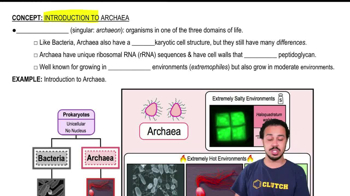
Introduction to Archaea
2874
views
29
rank
Guided course
05:54
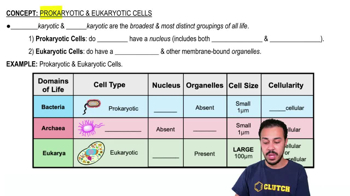
Prokaryotic & Eukaryotic Cells
3460
views
74
rank
Guided course
03:54
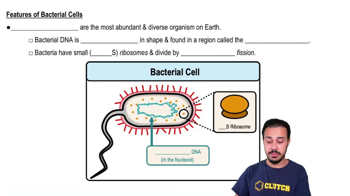
Features of Bacterial Cells
2788
views
38
rank
Terms in this set (15)
Hide definitions
Prokaryote
A cell type lacking a nucleus and membrane-bound organelles, found in domains Bacteria and Archaea.
Eukaryote
A cell type possessing a nucleus and membrane-bound organelles, found in domain Eukarya.
Bacteria
A domain of prokaryotic, unicellular organisms with circular DNA and cell walls containing peptidoglycan.
Archaea
A domain of prokaryotic, unicellular organisms with unique rRNA and cell walls lacking peptidoglycan.
Nucleus
A membrane-bound structure in eukaryotic cells that houses linear DNA.
Organelle
A specialized, membrane-bound structure within eukaryotic cells, absent in prokaryotes.
Nucleoid
A region in prokaryotic cells where circular DNA is located, not surrounded by a membrane.
Binary Fission
A simple cell division process used by prokaryotes to reproduce rapidly.
Ribosome
A molecular machine present in all cells, responsible for protein synthesis; smaller in prokaryotes.
Peptidoglycan
A unique molecule forming the bacterial cell wall, absent in archaea.
Extremophile
An organism, often an archaeon, thriving in extreme environments like high heat or salinity.
Cell Membrane
A boundary present in all cells, regulating the movement of substances in and out.
Unicellularity
A condition where an organism consists of a single cell, characteristic of all prokaryotes.
Circular DNA
A genetic material configuration found in prokaryotes, located in the nucleoid.
Domain
The highest taxonomic rank, grouping life into Bacteria, Archaea, and Eukarya.
 BackBack
 04:39
04:39