 Back
BackIntroduction to the Cytoskeleton exam



 03:15
03:15
Terms in this set (27)
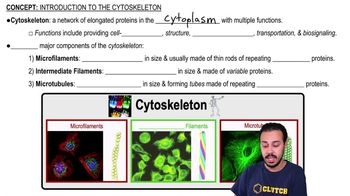
Define cytoskeleton.
A dynamic network of proteins in the cytoplasm, crucial for maintaining cell shape, structure, movement, and intracellular transport.
What are microfilaments?
The smallest components of the cytoskeleton, made of actin.
What are intermediate filaments composed of?
Various proteins.
What are Microtubules?
The largest components of the cytoskeleton, formed from tubulin.
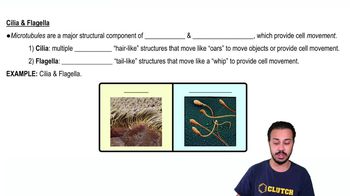
What is the function of cilia?
To move objects in the surroundings or provide cell movement.
Define Flagella.
Long, whip-like structures made of microtubules that provide cell movement.
What are the three main components of the cytoskeleton?
Microfilaments, intermediate filaments, and microtubules.
Define actin.
Protein subunits that make up microfilaments.
What is the role of the cytoskeleton in intracellular transport?
It helps in transporting molecules within the cell.
DefineTubulin.
Protein subunits that make up microtubules.
How do microtubules contribute to cell movement?
They are structural components of cilia and flagella, which facilitate cell movement.
What is the size order of the cytoskeleton components from smallest to largest?
Microfilaments, intermediate filaments, microtubules.
What are Cilia?
Short, hair-like structures made of microtubules that move like ores.
What is the primary function of flagella?
To provide cell movement.
Dynamic nature of the cytoskeleton
The ability to spontaneously break down and rebuild to meet the cell's needs.
What is the function of intermediate filaments?
To provide mechanical support and maintain cell integrity.
Define Bio signaling.
A function of the cytoskeleton that helps cells communicate and respond to their environment.
What are the structural components of cilia and flagella?
Microtubules.
How do microfilaments contribute to cell movement?
By interacting with motor proteins to generate force.
What is the main difference between cilia and flagella?
Cilia are short and numerous, while flagella are longer and fewer.
What is the role of actin in the cytoskeleton?
To form microfilaments, which are involved in cell movement and structure.
Who provide Mechanical support to cell?
Intermediate filaments in the cytoskeleton.
What does the term 'cyto' refer to?
Cell.
How do microtubules assist in intracellular transport?
By serving as tracks for motor proteins to move vesicles and organelles.
What is the significance of the cytoskeleton's dynamic nature?
It allows the cell to adapt its shape and function in response to changes.
What is Cell movement?
A function of the cytoskeleton facilitated by microfilaments, intermediate filaments, and microtubules.
What is the primary structural difference between microfilaments and microtubules?
Microfilaments are made of actin and are the smallest, while microtubules are made of tubulin and are the largest.