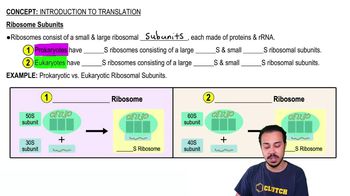
Which of these is the primary site of protein synthesis? Mitochondria, Cytoplasm, Nucleus, Ribosomes
Ribosomes are the primary site of protein synthesis.
What happens during the process of translation?
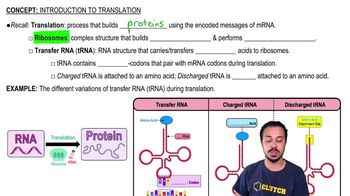
During translation, mRNA is used to synthesize proteins with the help of ribosomes and tRNAs.
Where does translation occur?
Translation occurs in the cytoplasm of the cell.
Which molecule does not play a direct role in translation?
DNA does not play a direct role in translation.
What is the role of tRNA during translation?
tRNA carries amino acids to the ribosome and matches its anticodon with mRNA codons.
What molecule is responsible for transferring amino acids to the ribosome during translation?
tRNA is responsible for transferring amino acids to the ribosome during translation.
What is produced during translation?
Proteins are produced during translation.
What is the function of a ribosome?
The function of a ribosome is to facilitate the synthesis of proteins by translating mRNA.
What is the product of RNA translation?
Protein is the product of RNA translation.
What is the specific site of translation?
The specific site of translation is the ribosome.
Where is bicoid mRNA translated?
Bicoid mRNA is translated in the cytoplasm.
What is the role of tRNA in protein synthesis?
tRNA's role in protein synthesis is to bring amino acids to the ribosome and match its anticodon with mRNA codons.
What is the role of ribosomes in protein synthesis?
Ribosomes facilitate the assembly of amino acids into proteins by translating mRNA.
Which is not something that occurs in translation? mRNA synthesis, Protein synthesis, tRNA binding, Codon-anticodon pairing
mRNA synthesis does not occur in translation.
What happens in translation?
In translation, mRNA is decoded by ribosomes to produce a specific polypeptide or protein.
Which molecule is not directly involved in translation?
DNA is not directly involved in translation.
Which component is not directly involved in translation? DNA, mRNA, tRNA, Ribosomes
DNA is not directly involved in translation.
What is the function of the ribosome?
The ribosome's function is to synthesize proteins by translating mRNA.
How is bacterial translation different from eukaryotic translation?
Bacterial translation occurs in the cytoplasm and can begin before transcription is complete, while eukaryotic translation occurs in the cytoplasm after mRNA processing.
What biological process does translation best describe?
Protein synthesis best describes translation.
Where in the cell does translation take place?
Translation takes place in the cytoplasm of the cell.
What does translation produce?
Translation produces proteins.
What occurs during the process of translation?
During translation, mRNA is decoded by ribosomes to synthesize proteins.
What process is responsible for linking amino acids together to form polypeptides?
Translation is responsible for linking amino acids together to form polypeptides.
How long would the peptide be that is translated from this mRNA sequence: 5'-AUGGGCUACCGU-3'?
The peptide would be 4 amino acids long.
What happens during translation termination?
During translation termination, a stop codon is reached, and the newly synthesized polypeptide is released from the ribosome.
Where in the cell is the information from the mRNA strand translated into a polypeptide chain?
The information from the mRNA strand is translated into a polypeptide chain in the cytoplasm.
What happens when a tRNA anticodon matches up with an mRNA codon?
When a tRNA anticodon matches up with an mRNA codon, the corresponding amino acid is added to the growing polypeptide chain.
What is the site of translation in a cell?
The ribosome is the site of translation.
What is the role of the ribosome in protein synthesis?
The ribosome's role in protein synthesis is to facilitate the assembly of amino acids into proteins by translating mRNA.
Which three items describe translation? DNA replication, Protein synthesis, mRNA decoding, Lipid synthesis
Protein synthesis, mRNA decoding, and ribosome involvement describe translation.
What is the function of the release factor during translation in eukaryotes?
The release factor binds to the stop codon, causing the release of the newly synthesized polypeptide from the ribosome.
What is the process of translation?
Translation is the process of synthesizing proteins using mRNA as a template.
Which component is directly involved in translation? DNA, mRNA, tRNA, Ribosomes
mRNA, tRNA, and ribosomes are directly involved in translation.
What happens when the ribosome reaches a nonsense codon?
When the ribosome reaches a nonsense codon, translation terminates, and the polypeptide is released.
What is the function of tRNA in translation?
tRNA carries amino acids to the ribosome and matches its anticodon with mRNA codons.
What is the process of translation best explained as?
Protein synthesis is the best explanation of the process of translation.
Which occurs during translation?
During translation, mRNA is decoded by ribosomes to synthesize proteins.
What is the point of translation?
The point of translation is to synthesize proteins using the information encoded in mRNA.
What are the roles of ribosomes in translation?
Ribosomes facilitate the assembly of amino acids into proteins by translating mRNA.
 Back
Back
 06:16
06:16