Skip to main content
General Biology
My Course
Learn
Exam Prep
AI Tutor
Study Guides
Textbook Solutions
Flashcards
Explore
Try the app
My Course
Learn
Exam Prep
AI Tutor
Study Guides
Textbook Solutions
Flashcards
Explore
Try the app
Back
Introduction to Translation quiz #3
You can tap to flip the card.
Which role do ribosomes play in protein synthesis?
You can tap to flip the card.
👆
Which role do ribosomes play in protein synthesis?
Ribosomes facilitate the assembly of amino acids into proteins by translating mRNA.
Track progress
Control buttons has been changed to "navigation" mode.
1/40
Related flashcards
Related practice
Recommended videos
Introduction to Translation definitions
Introduction to Translation
15 Terms
Introduction to Translation quiz #1
Introduction to Translation
19 Terms
Introduction to Translation exam
Introduction to Translation
19 Terms
Introduction to Translation
15. Gene Expression
3 problems
Topic
Jason
Steps of Translation
15. Gene Expression
4 problems
Topic
Jason
15. Gene Expression - Part 1 of 2
5 topics
10 problems
Chapter
Jason
15. Gene Expression - Part 2 of 2
6 topics
10 problems
Chapter
Jason
Guided course
06:16
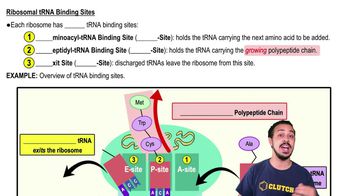
Ribosomal tRNA Binding Sites
14330
views
139
rank
2
comments
Guided course
08:42
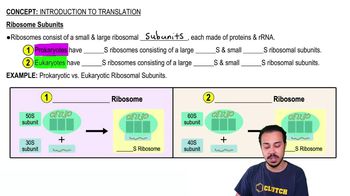
Ribosome Subunits
12871
views
137
rank
Guided course
06:12
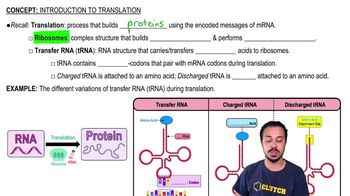
Introduction to Translation
16007
views
185
rank
1
comments
Terms in this set (40)
Hide definitions
Which role do ribosomes play in protein synthesis?
Ribosomes facilitate the assembly of amino acids into proteins by translating mRNA.
Where is the start codon located?
The start codon is located on the mRNA strand.
What role does tRNA play in translation?
tRNA carries amino acids to the ribosome and matches its anticodon with mRNA codons.
What is the stop codon that signals the end of translation?
The stop codons are UAA, UAG, and UGA.
Which organelle is the location where mRNA is translated into a protein?
The ribosome is the organelle where mRNA is translated into a protein.
What happens to the tRNA after it brings the amino acids to the ribosome?
After tRNA brings the amino acids to the ribosome, it exits the ribosome and can be recharged with another amino acid.
What is the start codon sequence that initiates translation?
The start codon sequence that initiates translation is AUG.
What is the first event to take place in translation in eukaryotes?
The first event is the binding of the small ribosomal subunit to the mRNA.
Which is a true statement about translation?
Translation is the process of synthesizing proteins using mRNA as a template.
What components are involved in the initiation of translation?
The small ribosomal subunit, mRNA, and initiator tRNA are involved in the initiation of translation.
What does translation involve in terms of molecular decoding?
Translation involves the decoding of mRNA to synthesize proteins.
What is the site of translation?
The site of translation is the ribosome.
Which tRNA is holding the correct anti-codon to match with the codon?
The tRNA with the anticodon complementary to the mRNA codon is holding the correct anti-codon.
Where does translation occur in eukaryotic cells and which molecules are involved?
Translation in eukaryotes occurs in the cytoplasm and involves ribosomes and tRNAs.
Where is the tRNA that is attached to the growing protein during translation?
The tRNA attached to the growing protein is located in the P site of the ribosome.
Where is the tRNA that is no longer holding an amino acid during translation?
The tRNA that is no longer holding an amino acid is located in the E site of the ribosome.
What must assemble during the initiation stage of translation?
The small ribosomal subunit, mRNA, and initiator tRNA must assemble during the initiation stage of translation.
Where does protein synthesis (translation) occur within eukaryotic cells?
Protein synthesis occurs at the ribosomes in the cytoplasm of eukaryotic cells.
What binds to the P site on a ribosome?
The tRNA carrying the growing polypeptide chain binds to the P site on a ribosome.
What is a possible product of translation?
A polypeptide or protein is a possible product of translation.
What is one major difference between eukaryotes and prokaryotes with respect to translation?
In eukaryotes, translation occurs in the cytoplasm after mRNA processing, while in prokaryotes, it can occur simultaneously with transcription.
What is the role of tRNA during protein synthesis?
tRNA carries amino acids to the ribosome and matches its anticodon with mRNA codons.
What role do aminoacyl tRNA synthetases play in translation?
Aminoacyl tRNA synthetases charge tRNAs with the correct amino acids.
How do ribosomes use mRNA and tRNA to assemble proteins?
Ribosomes use mRNA as a template and tRNA to bring amino acids, assembling them into proteins.
What is the function of the release factor in translation?
The release factor binds to the stop codon, causing the release of the newly synthesized polypeptide from the ribosome.
What is a polyribosome?
A polyribosome is a complex of multiple ribosomes translating a single mRNA simultaneously.
What is the role of aminoacyl-tRNA synthetase in protein synthesis?
Aminoacyl-tRNA synthetase charges tRNAs with the correct amino acids for protein synthesis.
How are amino acids assembled during translation?
Amino acids are assembled into a polypeptide chain by ribosomes using mRNA and tRNA.
Where does translation take place in the cell?
Translation takes place in the cytoplasm of the cell.
What molecules are involved in RNA translation?
mRNA, tRNA, and ribosomes are involved in RNA translation.
What is produced in translation?
Proteins are produced in translation.
What is the role of rRNA in translation?
rRNA is a component of ribosomes and helps facilitate protein synthesis during translation.
What is translation and where does it occur?
Translation is the process of protein synthesis using mRNA, and it occurs in the cytoplasm.
How is information converted in translation?
Information in mRNA is converted into a sequence of amino acids in a protein during translation.
Which best describes the process of translation?
Translation is the process of synthesizing proteins using mRNA as a template.
What is the function of ribosomes in protein synthesis?
Ribosomes facilitate the assembly of amino acids into proteins by translating mRNA.
What ensures that the correct amino acid is added during translation?
The anticodon of tRNA ensures that the correct amino acid is added by matching with the mRNA codon.
Which molecule is not a necessary component of translation: DNA, mRNA, tRNA, or ribosomes?
DNA is not a necessary component of translation.
What roles do tRNA and mRNA play in translation? Sort the descriptions to the appropriate bins.
tRNA carries amino acids and matches anticodons with mRNA codons; mRNA provides the template for protein synthesis.
What is the role of the anticodon in the process of translation?
The anticodon on tRNA pairs with the mRNA codon to ensure the correct amino acid is added.
 BackBack
 06:16
06:16