Skip to main content
General Biology
My Course
Learn
Exam Prep
AI Tutor
Study Guides
Textbook Solutions
Flashcards
Explore
Try the app
My Course
Learn
Exam Prep
AI Tutor
Study Guides
Textbook Solutions
Flashcards
Explore
Try the app
Back
Light Reactions of Photosynthesis exam
You can tap to flip the card.
Thylakoids
You can tap to flip the card.
👆
Thylakoids
Green pancake-like structures in chloroplasts where light reactions occur.
Track progress
Control buttons has been changed to "navigation" mode.
1/29
Related flashcards
Related practice
Recommended videos
Light Reactions of Photosynthesis definitions
Light Reactions of Photosynthesis
8 Terms
Light Reactions of Photosynthesis quiz #1
Light Reactions of Photosynthesis
19 Terms
Light Reactions of Photosynthesis quiz #2
Light Reactions of Photosynthesis
35 Terms
Light Reactions of Photosynthesis
9. Photosynthesis
7 problems
Topic
Jason
Calvin Cycle
9. Photosynthesis
4 problems
Topic
Jason
9. Photosynthesis - Part 1 of 2
6 topics
8 problems
Chapter
Jason
9. Photosynthesis - Part 2 of 2
5 topics
8 problems
Chapter
Jason
01:48
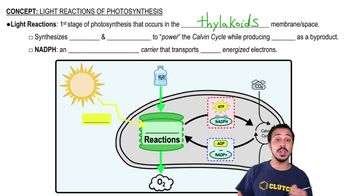
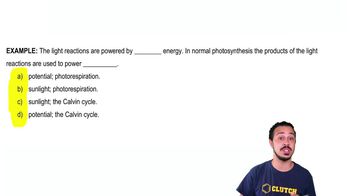
Light Reactions of Photosynthesis Example 1
11842
views
148
rank
04:06
Light Reactions of Photosynthesis
15879
views
196
rank
15:15
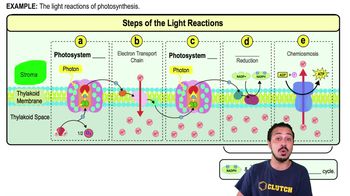
Steps of the Light Reactions
15573
views
194
rank
Terms in this set (29)
Hide definitions
Thylakoids
Green pancake-like structures in chloroplasts where light reactions occur.
What is the main purpose of the light reactions in photosynthesis?
To produce ATP and NADPH while releasing oxygen as a byproduct.
Photosystem II
The first photosystem in the light reactions that absorbs light and energizes electrons.
Where do the light reactions of photosynthesis take place?
In the thylakoid membranes of chloroplasts.
Electron Transport Chain (ETC)
A series of redox reactions that transfer electrons from photosystem II to photosystem I.
What is the role of water in the light reactions?
Water is split to provide electrons and produce oxygen gas.
Chemiosmosis
The process by which a hydrogen ion gradient is used to produce ATP.
What are the products of the light reactions?
ATP, NADPH, and oxygen gas.
Photosystem I
The second photosystem in the light reactions that re-energizes electrons.
What is NADP+?
An electron carrier that is reduced to NADPH in the light reactions.
ATP Synthase
An enzyme that uses the hydrogen ion gradient to produce ATP.
What is the final electron acceptor in the light reactions?
NADP+, which is reduced to NADPH.
Photon
A particle of light that provides energy for the light reactions.
What drives the synthesis of ATP in the light reactions?
The hydrogen ion gradient created by the electron transport chain.
Oxygen Gas (O2)
A byproduct of the light reactions produced from the splitting of water.
What is the role of photosystems in the light reactions?
To absorb light and energize electrons.
NADPH
An electron carrier that provides high-energy electrons for the Calvin cycle.
What happens to the electrons after they are energized in photosystem II?
They travel through the electron transport chain to photosystem I.
Hydrogen Ion Gradient
A concentration gradient of H+ ions that drives ATP synthesis.
What is the significance of the light reactions for the Calvin cycle?
The ATP and NADPH produced in the light reactions fuel the Calvin cycle.
Stroma
The fluid-filled space surrounding the thylakoids in chloroplasts.
What is the first step of the light reactions?
Photosystem II absorbs photons and energizes electrons.
Reduction of NADP+
The process of NADP+ gaining electrons to form NADPH.
What is the role of ATP in photosynthesis?
To provide energy for the Calvin cycle.
Light Harvesting Complexes
Structures in photosystems that contain pigments and proteins to absorb light.
What is the role of the electron transport chain in the light reactions?
To transfer electrons and create a hydrogen ion gradient.
Calvin Cycle
The second stage of photosynthesis that uses ATP and NADPH to synthesize glucose.
What happens to the oxygen produced in the light reactions?
It can be used for cellular respiration or released into the atmosphere.
Photophosphorylation
The process of generating ATP from ADP using the energy of sunlight.
 BackBack
 01:48
01:48