Back

Natural Selection definitions

Control buttons has been changed to "navigation" mode.
1/15
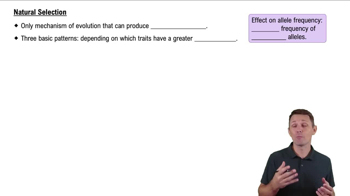
  • Natural Selection

    A mechanism of evolution that alters allele frequencies in predictable ways based on differential fitness among individuals.
  • Adaptation

    A trait shaped by evolutionary pressures that enhances an organism's ability to survive and reproduce in its environment.
  • Allele Frequency

    The proportion of a specific genetic variant among all copies of a gene in a population.
  • Directional Selection

    A pattern where one extreme phenotype is favored, shifting the population's average trait value toward that extreme.
  • Stabilizing Selection

    A pattern that favors average phenotypes, reducing variation by eliminating extremes from the population.
  • Disruptive Selection

    A pattern that favors both extremes of a trait, increasing variation and potentially leading to two distinct groups.
  • Balancing Selection

    A process maintaining multiple alleles in a population, preventing any single allele from reaching fixation.
  • Frequency-Dependent Selection

    A scenario where rare phenotypes are favored, maintaining genetic diversity as common traits become less advantageous.
  • Heterozygote Advantage

    A situation where individuals with two different alleles have higher fitness than those with identical alleles.
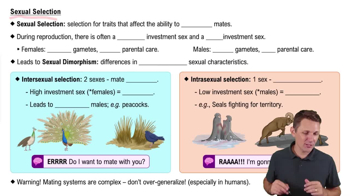
  • Sexual Selection

    A form of selection driven by traits that enhance success in obtaining mates, often leading to pronounced differences between sexes.
  • Sexual Dimorphism

    Distinct differences in appearance or size between males and females, not directly related to reproductive organs.
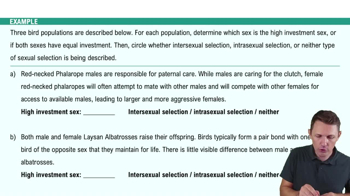
  • Intersexual Selection

    A process where one sex, often females, chooses mates based on specific traits, leading to elaborate displays or behaviors.
  • Intrasexual Selection

    A process involving competition within one sex, typically males, for access to mates or resources.
  • Fitness

    A measure of an individual's genetic contribution to the next generation, influenced by survival and reproductive success.
  • Phenotype

    The observable characteristics of an organism, shaped by genetic and environmental factors.