 Back
BackNoncovalent Bonds exam


 03:40
03:40
Terms in this set (28)
Non-covalent bonds
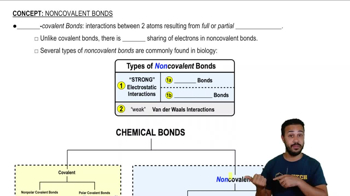
Interactions between atoms resulting from full or partial charges without electron sharing.
What distinguishes non-covalent bonds from covalent bonds?
Non-covalent bonds do not involve the sharing of electrons, unlike covalent bonds.
Ionic bonds
A type of non-covalent bond that involves electrostatic interactions between fully charged atoms.
Hydrogen bonds
A type of non-covalent bond involving electrostatic interactions between a hydrogen atom and an electronegative atom.
Van der Waals interactions
Weak non-covalent interactions important in chemistry but less emphasized in biological contexts.
What are the two main types of strong electrostatic interactions in non-covalent bonds?
Ionic bonds and hydrogen bonds.
Electrostatic interactions
Interactions between charged particles, which can be relatively strong in the context of non-covalent bonds.
What role do non-covalent bonds play in biological systems?
They influence molecular interactions, enzyme activity, and cellular communication.
Full charges
Complete positive or negative charges on atoms, often involved in ionic bonds.
Partial charges
Slight positive or negative charges on atoms, often involved in hydrogen bonds.
Why are Van der Waals interactions less emphasized in biology courses?
They are weaker and more relevant to chemistry than to biological processes.
What is the significance of understanding non-covalent bonds in biology?
It is crucial for grasping molecular interactions and biological processes.
Enzyme activity
A biological process influenced by non-covalent bonds.
Cellular communication
A biological process influenced by non-covalent bonds.
What does the term 'non-covalent' imply?
No sharing of electrons.
What are the two groups of non-covalent bonds?
Relatively strong electrostatic interactions and weak Van der Waals interactions.
What type of bond involves a hydrogen atom and an electronegative atom?
Hydrogen bond.
What type of bond involves full charges on atoms?
Ionic bond.
What is the focus of non-covalent bond studies in biology courses?
Relatively strong electrostatic interactions, such as ionic and hydrogen bonds.
What is the main difference between covalent and non-covalent bonds?
Covalent bonds involve electron sharing; non-covalent bonds do not.
What are weak Van der Waals interactions?
Non-covalent interactions that are less emphasized in biological contexts.
What is the importance of ionic bonds in biological systems?
They are strong electrostatic interactions crucial for molecular interactions.
What is the importance of hydrogen bonds in biological systems?
They are strong electrostatic interactions crucial for molecular interactions.
What does the term 'electrostatic interactions' refer to?
Interactions between charged particles.
What are the key types of non-covalent bonds?
Ionic bonds, hydrogen bonds, and Van der Waals interactions.
What is the role of non-covalent bonds in enzyme activity?
They influence the molecular interactions necessary for enzyme function.
What is the role of non-covalent bonds in cellular communication?
They influence the molecular interactions necessary for cellular signaling.
What is a key characteristic of non-covalent bonds?
They arise from full or partial charges without electron sharing.