 Back
BackOrganization of DNA in the Cell exam

 05:46
05:46
Terms in this set (25)
Genome
The complete set of all of a cell's DNA.
What is the role of histone proteins in DNA organization?
Histone proteins associate with DNA to form nucleosomes, aiding in the organization and packaging of DNA.
Nucleosome
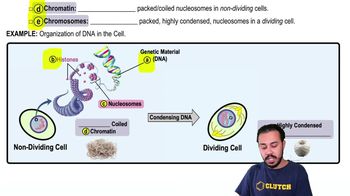
A unit of 8 histone proteins with DNA wrapped around it.
What is chromatin?
Loosely packed nucleosomes found in non-dividing cells.
Chromosome
Tightly packed nucleosomes found in dividing cells.
What happens to DNA during cell division?
DNA condenses into tightly packed chromosomes to facilitate its movement within the cell.
DNA Replication
The process of producing an exact copy of all the DNA in a cell.
What are sister chromatids?
Two identical chromatids joined at the centromere, formed after DNA replication.
Centromere
The region where two sister chromatids are joined, often referred to as the 'waist' of the chromosome.
What is the difference between chromatin and chromosomes?
Chromatin is loosely packed DNA found in non-dividing cells, while chromosomes are tightly packed DNA found in dividing cells.
What is the significance of DNA replication before cell division?
It ensures that each daughter cell receives an exact copy of the DNA.
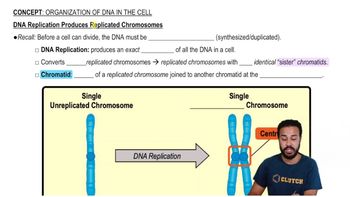
Unreplicated Chromosome
A chromosome that has not yet undergone DNA replication, appearing as a single straight line.
What does a replicated chromosome look like?
It resembles an 'X' shape, consisting of two sister chromatids joined at the centromere.
DNA Synthesis
Another term for DNA replication, the process of creating an exact copy of DNA.
What is the function of nucleosomes in non-dividing cells?
They form chromatin, which is loosely packed to allow access to DNA for transcription and other processes.
What is the structure of a nucleosome?
It consists of a core of 8 histone proteins with DNA wrapped around it.
Sister Chromatids
Identical copies of a chromosome connected by a centromere, formed during DNA replication.
What is the role of the centromere during cell division?
It holds sister chromatids together, ensuring they are properly segregated into daughter cells.
Chromatin
Loosely coiled DNA and protein complex found in non-dividing cells.
What is the difference between DNA replication and DNA synthesis?
There is no difference; both terms refer to the process of making an exact copy of DNA.
Replicated Chromosome
A chromosome that has undergone DNA replication, consisting of two sister chromatids.
What is the purpose of DNA condensation into chromosomes during cell division?
To ensure efficient and accurate segregation of DNA into daughter cells.
Histone Proteins
Proteins that DNA wraps around to form nucleosomes, aiding in DNA packaging.
What is the appearance of chromatin in a non-dividing cell?
It appears as a loosely coiled ball of yarn, allowing access to DNA.
What is the significance of the genome in a cell?
It contains the complete set of genetic information necessary for the cell's functions and inheritance.