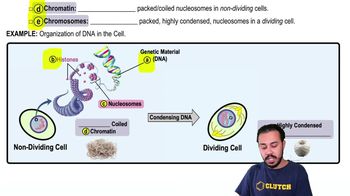
How is DNA organized within a non-dividing cell compared to a dividing cell, and what are the terms used to describe these forms?
In a non-dividing cell, DNA is organized as chromatin, which consists of loosely packed nucleosomes. In a dividing cell, DNA condenses into tightly packed structures called chromosomes.
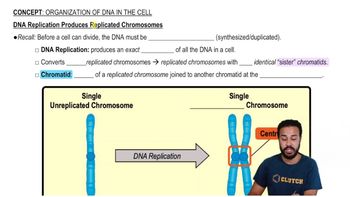
What is a replicated chromosome, and how are sister chromatids and the centromere involved in its structure?
A replicated chromosome consists of two identical sister chromatids joined together at a region called the centromere. Each chromatid is an exact copy of the DNA, and the centromere holds them together until they are separated during cell division.
What is the genome in a cell?
The genome is the complete set of all of a cell's DNA. It contains all the genetic information necessary for the organism.
What are histone proteins and what role do they play in DNA organization?
Histone proteins are proteins around which DNA wraps to form nucleosomes. They help package and organize DNA within the cell.
What is a nucleosome and how is it structured?
A nucleosome consists of a core of 8 histone proteins with DNA wrapped around it. It is the basic unit of DNA packaging in eukaryotic cells.
How is DNA organized in a non-dividing cell and what is this form called?
In a non-dividing cell, DNA is organized as loosely packed nucleosomes called chromatin. Chromatin allows the DNA to be accessible for processes like transcription.
How does DNA organization change in a dividing cell and what is this form called?
In a dividing cell, DNA condenses into tightly packed structures called chromosomes. This condensation is important for proper segregation of DNA during cell division.
What is the difference between chromatin and chromosomes?
Chromatin is loosely packed DNA found in non-dividing cells, while chromosomes are tightly packed DNA found in dividing cells. Both forms consist of DNA wrapped around histone proteins.
What is a replicated chromosome and how are sister chromatids involved?
A replicated chromosome consists of two identical sister chromatids joined together. Each chromatid is an exact copy of the DNA, and they are held together at the centromere.
What is the centromere and what is its function in a replicated chromosome?
The centromere is the region where two sister chromatids are joined in a replicated chromosome. It acts as the 'waist' of the chromosome and is crucial for proper chromosome separation during cell division.