Which structure will you find in a prokaryotic cell?
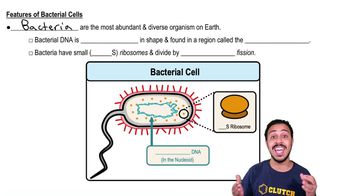
You will find ribosomes in a prokaryotic cell.
How does the genetic material differ between eukaryotes and prokaryotes?
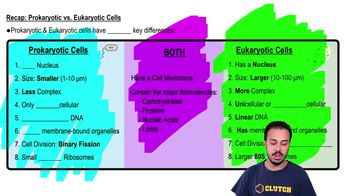
Eukaryotes have linear DNA, while prokaryotes have circular DNA.
What do plant and animal cells have in common?
Both have a nucleus, cell membrane, and various organelles.
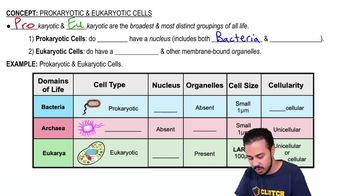
Which type of cells lack a true nucleus and membrane-bound organelles?
Prokaryotic cells lack a true nucleus and membrane-bound organelles.
What cell structures are only found in eukaryotic cells?
A nucleus and membrane-bound organelles are only found in eukaryotic cells.
Which organelle is found in both prokaryotes and eukaryotes?
Ribosomes are found in both prokaryotes and eukaryotes.
How do the prokaryotic cells appear different from the eukaryotic cells?
Prokaryotic cells lack a nucleus and are smaller, while eukaryotic cells have a nucleus and are larger.
What characteristics are found in both eukaryotes and prokaryotes?
Both have a cell membrane and ribosomes.
What observations do you have about the bacteria cell?
Bacteria cells are prokaryotic, lack a nucleus, and have circular DNA.
In eukaryotes, where is the DNA located?
In eukaryotes, DNA is located inside the nucleus.
What is the main structural difference between prokaryotic and eukaryotic cells?
Prokaryotic cells lack a nucleus and membrane-bound organelles, while eukaryotic cells have a nucleus and various membrane-bound organelles.
What type of DNA do prokaryotic cells possess, and where is it located?
Prokaryotic cells have circular DNA located in a region called the nucleoid.
What is the typical size range of prokaryotic cells compared to eukaryotic cells?
Prokaryotic cells are typically 1–10 micrometers, while eukaryotic cells are 10–100 micrometers in size.
What process do eukaryotic cells use to divide?
Eukaryotic cells divide by mitosis and cytokinesis.
Can eukaryotic cells be both unicellular and multicellular?
Yes, eukaryotic cells can be either unicellular or multicellular.
How do the ribosomes of prokaryotic and eukaryotic cells differ?
Prokaryotic cells have smaller 70S ribosomes, while eukaryotic cells have larger 80S ribosomes.
What does the prefix 'eu-' in 'eukaryotic' mean?
The prefix 'eu-' means 'good' or 'true,' referring to the presence of a true nucleus.
Where is the DNA found in a eukaryotic cell?
DNA in a eukaryotic cell is found inside the nucleus.
Which organisms are the most ancient and diverse on Earth?
Bacteria, which are prokaryotic, are the most ancient and diverse organisms.
Do all cells have a cell membrane?
Yes, all cells, both prokaryotic and eukaryotic, have a cell membrane.
Which type of cell is found in humans?
Humans are made up of eukaryotic cells.
What is mitosis?
Mitosis is a complex process of cell division used by eukaryotic cells.
Which cell type is generally larger, prokaryotic or eukaryotic?
Eukaryotic cells are generally larger than prokaryotic cells.
Do prokaryotic cells have membrane-bound organelles?
No, prokaryotic cells do not have membrane-bound organelles.
What is the shape of prokaryotic DNA?
Prokaryotic DNA is circular.
What is the function of the cell membrane?
The cell membrane controls the movement of substances in and out of the cell.
What is the main difference in cell division between prokaryotic and eukaryotic cells?
Prokaryotic cells divide by binary fission, while eukaryotic cells divide by mitosis and cytokinesis.
Which type of ribosome is found in eukaryotic cells?
Eukaryotic cells have 80S ribosomes.
What is the significance of the 'S' in 70S and 80S ribosomes?
The 'S' refers to the size and sedimentation rate of the ribosome.
Which cell type lacks a true nucleus?
Prokaryotic cells lack a true nucleus.
Are archaea prokaryotic or eukaryotic?
Archaea are prokaryotic.
Are plants prokaryotic or eukaryotic?
Plants are eukaryotic.
What is the main function of organelles in eukaryotic cells?
Organelles perform specialized functions within the cell.
Which cell type is found in the domain Eukarya?
Eukaryotic cells are found in the domain Eukarya.
Which cell type is capable of forming complex multicellular organisms?
Eukaryotic cells are capable of forming complex multicellular organisms.
What is the main difference in ribosome size between prokaryotic and eukaryotic cells?
Prokaryotic ribosomes are smaller (70S) than eukaryotic ribosomes (80S).
What is the main function of DNA in cells?
DNA stores genetic information necessary for cell function and reproduction.
What is the main difference in cellularity between prokaryotic and eukaryotic cells?
Prokaryotic cells are always unicellular, while eukaryotic cells can be unicellular or multicellular.
What is the main function of the cell membrane in both cell types?
The cell membrane regulates the passage of substances into and out of the cell.
What is the main difference in the way prokaryotic and eukaryotic cells store their DNA?
Prokaryotic cells store DNA in the nucleoid as a single circular molecule, while eukaryotic cells store DNA in the nucleus as multiple linear chromosomes.
 Back
Back

 04:26
04:26