Skip to main content
General Biology
My Course
Learn
Exam Prep
AI Tutor
Study Guides
Textbook Solutions
Flashcards
Explore
Try the app
My Course
Learn
Exam Prep
AI Tutor
Study Guides
Textbook Solutions
Flashcards
Explore
Try the app
Back
Prokaryotic & Eukaryotic Cells quiz #9
You can tap to flip the card.
Which domains of life consist of prokaryotic cells?
You can tap to flip the card.
👆
Which domains of life consist of prokaryotic cells?
The domains Bacteria and Archaea consist of prokaryotic cells.
Track progress
Control buttons has been changed to "navigation" mode.
1/39
Related flashcards
Related practice
Recommended videos
Prokaryotic & Eukaryotic Cells definitions
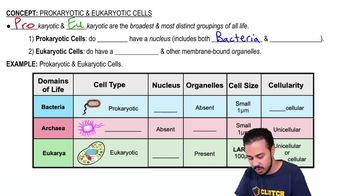
Prokaryotic & Eukaryotic Cells
18 Terms
Prokaryotic & Eukaryotic Cells quiz #1
Prokaryotic & Eukaryotic Cells
51 Terms
Prokaryotic & Eukaryotic Cells exam
Prokaryotic & Eukaryotic Cells
29 Terms
Prokaryotic & Eukaryotic Cells
5. Cell Components
7 problems
Topic
Jason
Introduction to Eukaryotic Organelles
5. Cell Components
5 problems
Topic
Jason
5. Cell Components
9 topics
15 problems
Chapter
Brendan
04:26
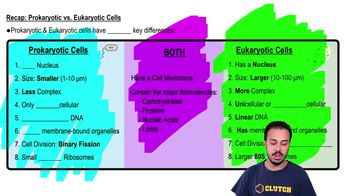
Recap: Prokaryotic vs. Eukaryotic Cells
24207
views
417
rank
05:54
Prokaryotic & Eukaryotic Cells
40342
views
888
rank
4
comments
03:54
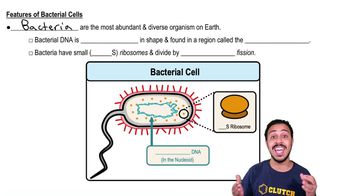
Features of Bacterial Cells
29361
views
520
rank
1
comments
Terms in this set (39)
Hide definitions
Which domains of life consist of prokaryotic cells?
The domains Bacteria and Archaea consist of prokaryotic cells.
How does the DNA in eukaryotic cells differ from that in prokaryotic cells?
Eukaryotic cells have linear DNA contained within a nucleus, while prokaryotic cells have circular DNA in the nucleoid.
How do prokaryotic cells reproduce?
Prokaryotic cells reproduce by binary fission.
Are prokaryotic cells unicellular or multicellular?
Prokaryotic cells are always unicellular.
What is the function of ribosomes in both prokaryotic and eukaryotic cells?
Ribosomes are responsible for building proteins in both cell types.
What does the prefix 'pro-' in 'prokaryotic' mean?
The prefix 'pro-' means 'before,' indicating prokaryotic cells evolved before the nucleus.
Which type of cell contains membrane-bound organelles?
Eukaryotic cells contain membrane-bound organelles.
What is the nucleoid?
The nucleoid is the region in prokaryotic cells where circular DNA is located.
What is the main difference in complexity between prokaryotic and eukaryotic cells?
Eukaryotic cells are more complex due to their larger size and presence of organelles.
What major biomolecules are found in both prokaryotic and eukaryotic cells?
Both cell types contain carbohydrates, proteins, nucleic acids, and lipids.
What is binary fission?
Binary fission is a simple cell division process used by prokaryotic cells.
What is the main function of the nucleus in eukaryotic cells?
The nucleus houses and protects the cell's linear DNA.
What is the role of ribosomes in the cell?
Ribosomes synthesize proteins.
What is the shape of eukaryotic DNA?
Eukaryotic DNA is linear.
Which cell type can form multicellular organisms?
Eukaryotic cells can form multicellular organisms.
Which cell type is less complex, prokaryotic or eukaryotic?
Prokaryotic cells are less complex.
What is the function of the nucleoid in prokaryotic cells?
The nucleoid contains the cell's circular DNA.
Which type of ribosome is found in prokaryotic cells?
Prokaryotic cells have 70S ribosomes.
Which cell type contains a true nucleus?
Eukaryotic cells contain a true nucleus.
What is the main advantage of having membrane-bound organelles?
Membrane-bound organelles allow compartmentalization and specialization of cellular functions.
Are bacteria prokaryotic or eukaryotic?
Bacteria are prokaryotic.
Are animals prokaryotic or eukaryotic?
Animals are eukaryotic.
What is the evolutionary significance of prokaryotic cells?
Prokaryotic cells are the most ancient and were the first forms of life on Earth.
What is the main difference in DNA location between prokaryotic and eukaryotic cells?
Prokaryotic DNA is in the nucleoid, while eukaryotic DNA is in the nucleus.
What is the primary method of reproduction in bacteria?
Bacteria reproduce primarily by binary fission.
Do both prokaryotic and eukaryotic cells contain genetic material?
Yes, both contain genetic material (DNA).
Which cell type is more likely to have specialized internal compartments?
Eukaryotic cells are more likely to have specialized internal compartments due to organelles.
Which cell type is found in fungi?
Fungi are made up of eukaryotic cells.
Which cell type is generally simpler in structure?
Prokaryotic cells are generally simpler in structure.
Which cell type is found in protists?
Protists are made up of eukaryotic cells.
What is the main difference in the presence of organelles between prokaryotic and eukaryotic cells?
Eukaryotic cells have membrane-bound organelles; prokaryotic cells do not.
Which cell type is more likely to be found in extreme environments, bacteria or archaea?
Archaea are more likely to be found in extreme environments.
Which structure is common to both plant and animal cells?
Both plant and animal cells have a cell membrane, nucleus, cytoplasm, and ribosomes.
What do animal cells have that plant cells do not?
Animal cells have structures such as centrioles and lysosomes, which are generally not found in plant cells.
Which structure is not found in plant cells?
Centrioles are typically not found in plant cells.
What is found in both plant and animal cells?
Both plant and animal cells contain a nucleus, cell membrane, cytoplasm, and ribosomes.
What do plant cells have that animal cells do not?
Plant cells have a cell wall and chloroplasts, which are not found in animal cells.
What do both plant and animal cells have in common?
Both plant and animal cells have a nucleus, cell membrane, cytoplasm, and ribosomes.
What is found in plant cells and not animal cells?
Plant cells have a cell wall and chloroplasts, which are not present in animal cells.
 BackBack

 04:26
04:26