Skip to main content
General Biology
My Course
Learn
Exam Prep
AI Tutor
Study Guides
Textbook Solutions
Flashcards
Explore
Try the app
My Course
Learn
Exam Prep
AI Tutor
Study Guides
Textbook Solutions
Flashcards
Explore
Try the app
Back
Review of Photosynthesis exam
You can tap to flip the card.
Chloroplast
You can tap to flip the card.
👆
Chloroplast
Organelle where photosynthesis occurs.
Track progress
Control buttons has been changed to "navigation" mode.
1/30
Related flashcards
Related practice
Recommended videos
Review of Photosynthesis definitions
Review of Photosynthesis
10 Terms
Review of Photosynthesis quiz #1
Review of Photosynthesis
13 Terms
Review of Photosynthesis quiz #1
Review of Photosynthesis
38 Terms
Review of Photosynthesis
9. Photosynthesis
2 problems
Topic
Brendan
C3, C4 & CAM Plants
9. Photosynthesis
3 problems
Topic
Jason
9. Photosynthesis - Part 1 of 2
6 topics
8 problems
Chapter
Jason
9. Photosynthesis - Part 2 of 2
5 topics
8 problems
Chapter
Jason
08:50
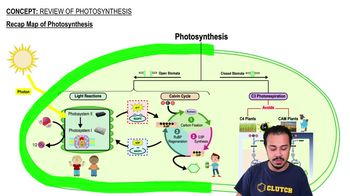
Recap Map of Photosynthesis
8679
views
86
rank
1
comments
02:06
Review of Photosynthesis Example 1
6606
views
65
rank
Terms in this set (30)
Hide definitions
Chloroplast
Organelle where photosynthesis occurs.
What are the two stages of photosynthesis?
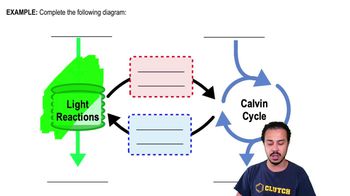
Light reactions and the Calvin cycle.
Thylakoids
Green pancake-like structures in chloroplasts where light reactions occur.
What is the main function of light reactions?
To generate ATP and NADPH by utilizing photons to split water.
Calvin cycle
Second stage of photosynthesis that produces glucose using ATP, NADPH, and CO2.
What is photorespiration?
A process where plants consume oxygen and release CO2, wasting energy.
C4 plants
Plants that separate light reactions and the Calvin cycle into mesophyll and bundle sheath cells to avoid photorespiration.
What is the role of stomata?
Pores in leaves that control gas exchange.
CAM plants
Plants that fix carbon at night and during the day to survive in hot, dry environments.
What are the products of light reactions?
ATP, NADPH, and oxygen.
Photosystem II
The first photosystem in the light reactions that absorbs light and splits water.
What enzyme is used in the carbon fixation phase of the Calvin cycle?
Rubisco.
NADPH
An electron carrier produced in the light reactions and used in the Calvin cycle.
What is the first stable three-carbon molecule in the Calvin cycle?
PGA.
RuBP
The molecule that CO2 is fixed to in the Calvin cycle.
What mnemonic helps remember the Calvin cycle reactants?
Calvin's can of sugar (C for CO2, A for ATP, N for NADPH).
Chemiosmosis
Process in light reactions that produces ATP.
What happens to ATP and NADPH after the Calvin cycle?
They are converted to ADP and NADP+.
Mesophyll cell
Cell type in C4 plants where light reactions occur.
What is the role of photosystem I?
To absorb light and help produce NADPH.
Bundle sheath cell
Cell type in C4 plants where the Calvin cycle occurs.
What is the significance of oxygen produced in light reactions?
It can be used for cellular respiration or released into the environment.
G3P
A molecule produced in the Calvin cycle that is a precursor to glucose.
What adaptation helps CAM plants survive in deserts?
Fixing carbon at night to reduce water loss.
Electron transport chain
A series of proteins in the thylakoid membrane that transfer electrons during light reactions.
What is the role of water in light reactions?
It is split to provide electrons and produce oxygen.
Photorespiration mainly occurs in which type of plants?
C3 plants.
What are the three phases of the Calvin cycle?
Carbon fixation, G3P synthesis, and RuBP regeneration.
Photons
Particles of light used in light reactions.
What is the final product of the Calvin cycle?
Glucose.
 BackBack

 08:50
08:50