Which of the following is not an adaptation for reducing the rate of heat loss to the environment?
a. Feathers or fur
b. Increasing blood flow to surface blood vessels
c. Huddling behavior of penguins
d. Countercurrent heat exchange
Taylor, Simon, Dickey, Hogan 10th Edition
Ch. 25 Control of Body Temperature and Water Balance
Problem 6
Verified step by step guidance
Which of the following is not an adaptation for reducing the rate of heat loss to the environment?
a. Feathers or fur
b. Increasing blood flow to surface blood vessels
c. Huddling behavior of penguins
d. Countercurrent heat exchange
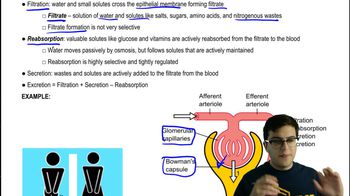
In each nephron of the kidney, the glomerulus and Bowman's capsule
a. Filter the blood and capture the filtrate.
b. Reabsorb water into the blood.
c. Break down harmful toxins and poisons.
d. Refine and concentrate the urine for excretion.
As filtrate passes through the loop of Henle, salt is reabsorbed and concentrated in the interstitial fluid of the medulla. This high solute concentration in the medulla enables nephrons to
a. Excrete the maximum amount of salt.
b. Neutralize toxins that might be found in the kidney.
c. Excrete a large amount of water.
d. Reabsorb water from the filtrate very efficiently.
A freshwater fish would be expected to
a. Pump salt out through its gills.
b. Produce copious quantities of dilute urine.
c. Have scales and a covering of mucus that reduce water loss to the environment.
d. Do all of the above.
Match each of the following components of blood (on the left) with what happens to it as the blood is processed by the kidney (on the right). Note that each lettered choice may be used more than once.
8. Water
9. Glucose
10. Plasma protein
11. Toxins or drugs
12. Red blood cell
13. Urea
a. passes into filtrate; almost all excreted in urine
b. remains in blood
c. passes into filtrate; mostly reabsorbed
d. secreted and excreted
You are in a room of empty chairs. As the chairs fill with people, you become hotter and hotter. A ceiling fan is turned on, and you feel cooler. You gained heat by _________ and lost heat to the environment by _________ .
a. Conduction … convection
b. Radiation … convection
c. Radiation … conduction
d. Convection … radiation