

Pearson+ LogoPearson+ Logo
Ch. 25 Control of Body Temperature and Water Balance
Taylor - Campbell Biology: Concepts & Connections 10th Edition
Taylor, Simon, Dickey, Hogan10th EditionCampbell Biology: Concepts & ConnectionsISBN: 9780136538783Not the one you use?Change textbook
Chapter 25, Problem 7

A freshwater fish would be expected to
a. Pump salt out through its gills.
b. Produce copious quantities of dilute urine.
c. Have scales and a covering of mucus that reduce water loss to the environment.
d. Do all of the above.

Verified step by step guidance
1
Understand the environment: Freshwater fish live in a hypotonic environment, meaning the concentration of solutes (like salts) is lower in the surrounding water compared to the fish's body fluids. This causes water to naturally flow into the fish's body by osmosis.
Analyze the fish's adaptations: To maintain homeostasis, freshwater fish must regulate water and salt levels. They need to expel excess water and retain essential salts.
Evaluate option b: Freshwater fish produce large amounts of dilute urine to remove the excess water that enters their bodies through osmosis.
Evaluate option a: Freshwater fish do not pump salt out through their gills. Instead, they actively absorb salts through specialized cells in their gills to compensate for the loss of salts to the environment.
Evaluate option c: Scales and mucus help reduce water loss in some fish, but this is more relevant for marine or terrestrial environments. Freshwater fish are more concerned with water influx rather than water loss. Based on this analysis, determine which options are correct.

Verified video answer for a similar problem:

This video solution was recommended by our tutors as helpful for the problem above.
Video duration:
1m
Was this helpful?

Key Concepts

Here are the essential concepts you must grasp in order to answer the question correctly.

Osmoregulation

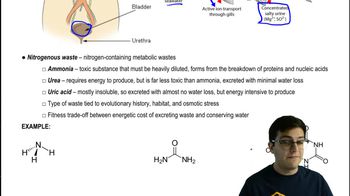
Osmoregulation is the process by which organisms regulate the water and electrolyte balance in their bodies to maintain homeostasis. Freshwater fish, which live in an environment where the water concentration is higher than their bodily fluids, must actively expel excess water and retain salts to survive. This involves physiological adaptations such as specialized gills and kidney functions.
Recommended video:
Guided course
07:16
Osmoregulation and Nitrogenous Waste

Dilute Urine Production

Freshwater fish produce large volumes of dilute urine to eliminate excess water absorbed from their environment. This adaptation helps them maintain osmotic balance by ensuring that their internal salt concentration remains higher than that of the surrounding water. The kidneys of these fish are adapted to filter out excess water while retaining necessary ions.
Recommended video:
Guided course
04:36
Primary Production in Aquatic Ecosystems

Protective Body Coverings

The scales and mucus covering of freshwater fish serve as protective barriers that minimize water loss and provide a defense against pathogens. The mucus layer is particularly important as it helps reduce friction and can also contain antimicrobial properties. These adaptations are crucial for maintaining hydration and overall health in a hypotonic environment.
Recommended video:
Guided course
04:08
2) mRNA Protection in the Cytoplasm
Related Practice
Textbook Question

In each nephron of the kidney, the glomerulus and Bowman's capsule

a. Filter the blood and capture the filtrate.

b. Reabsorb water into the blood.

c. Break down harmful toxins and poisons.

d. Refine and concentrate the urine for excretion.

1531
views
Textbook Question

As filtrate passes through the loop of Henle, salt is reabsorbed and concentrated in the interstitial fluid of the medulla. This high solute concentration in the medulla enables nephrons to

a. Excrete the maximum amount of salt.

b. Neutralize toxins that might be found in the kidney.

c. Excrete a large amount of water.

d. Reabsorb water from the filtrate very efficiently.

2322
views
Textbook Question

Birds and insects excrete uric acid, whereas mammals and most amphibians excrete mainly urea. What is the chief advantage of uric acid over urea as a waste product?

a. Uric acid is a much simpler molecule.

b. It takes less energy to make uric acid.

c. Less water is required to excrete uric acid.

d. More solutes are removed excreting uric acid.

2313
views
Textbook Question

Match each of the following components of blood (on the left) with what happens to it as the blood is processed by the kidney (on the right). Note that each lettered choice may be used more than once.


8. Water

9. Glucose

10. Plasma protein

11. Toxins or drugs

12. Red blood cell

13. Urea


a. passes into filtrate; almost all excreted in urine

b. remains in blood

c. passes into filtrate; mostly reabsorbed

d. secreted and excreted

1240
views
Textbook Question

You are in a room of empty chairs. As the chairs fill with people, you become hotter and hotter. A ceiling fan is turned on, and you feel cooler. You gained heat by _________ and lost heat to the environment by _________ .

a. Conduction … convection

b. Radiation … convection

c. Radiation … conduction

d. Convection … radiation

758
views
Textbook Question

Which process in the nephron is least selective?

a. Secretion

b. Reabsorption

c. Filtration

d. Passive diffusion of salt

1108
views