Pearson+ LogoPearson+ Logo
Ch. 25 Control of Body Temperature and Water Balance
Taylor - Campbell Biology: Concepts & Connections 10th Edition
Taylor, Simon, Dickey, Hogan10th EditionCampbell Biology: Concepts & ConnectionsISBN: 9780136538783Not the one you use?Change textbook
Chapter 25, Problem 20

You are studying a large tropical reptile that has a high and relatively stable body temperature. How would you determine whether this animal is an endotherm or an ectotherm?

Verified step by step guidance
1
Observe the reptile's behavior and body temperature in different environmental conditions. Note if the body temperature fluctuates significantly with changes in the ambient temperature.
Measure the metabolic rate of the reptile under controlled conditions. This can be done by measuring the oxygen consumption, which is an indicator of metabolic rate. Compare these rates in both warm and cool environments.
Analyze the insulation mechanisms of the reptile, such as fat layers or specialized scales, which could help in maintaining a stable body temperature independent of the environment.
Examine the reptile's physiological responses to temperature changes, such as shivering or sweating, which can indicate mechanisms for internal heat production or cooling.
Compare your findings with known characteristics of endotherms and ectotherms. Endotherms typically maintain a stable body temperature through internal heat production, while ectotherms rely on external heat sources.

Verified video answer for a similar problem:

This video solution was recommended by our tutors as helpful for the problem above.
Video duration:
2m
Was this helpful?

Key Concepts

Here are the essential concepts you must grasp in order to answer the question correctly.

Endothermy

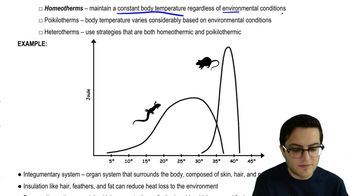
Endothermy refers to the ability of an organism to regulate its body temperature internally, maintaining a stable temperature regardless of external environmental conditions. Endotherms, such as mammals and birds, generate heat through metabolic processes, allowing them to thrive in various habitats, including extreme climates.
Recommended video:
Guided course
09:51
Thermoregulation

Ectothermy

Ectothermy is the reliance on external environmental sources to regulate body temperature. Ectotherms, like reptiles and amphibians, absorb heat from their surroundings, which can lead to fluctuating body temperatures that depend on the ambient environment. This strategy often results in lower metabolic rates compared to endotherms.
Recommended video:
Guided course
09:51
Thermoregulation

Thermoregulation

Thermoregulation is the process by which organisms maintain their internal body temperature within a certain range, crucial for optimal physiological functioning. This can involve behavioral adaptations, such as basking in the sun or seeking shade, as well as physiological mechanisms like altering metabolic rates. Understanding thermoregulation helps distinguish between endothermic and ectothermic strategies.
Recommended video:
Guided course
09:51
Thermoregulation
Related Practice
Textbook Question
Can ectotherms have stable body temperatures? Explain.
1293
views
Textbook Question
Two endothermic animals are the same size, but one is a carnivore and the other is an herbivore. Predict which of these animals would produce the greatest amount of nitrogenous wastes. Explain.
968
views
Textbook Question
Some diuretics are on a list of substances that the International Olympic Committee has banned for use by athletes. What do diuretics do? Propose an explanation for how diuretic use could be an unfair advantage for a competitor in a sport like wrestling, in which weight classes are part of the competition.
813
views
Textbook Question

For the experiment detailed in Module 25.3, describe the control and experimental groups, state the dependent variable being measured, and summarize the result.

939
views
Textbook Question
Dolphins have an insulating layer of blubber that protects them from cold water, but their flippers are not insulated. Propose a hypothesis to explain why dolphin flippers do not freeze. Describe an experiment you could do to test your hypothesis. (You may assume you have equipment for measuring temperatures in dolphin flippers.) What results would you expect if your hypothesis is correct?
910
views
Textbook Question
In 1847, the German biologist Christian Bergmann noted that mammals and birds living at higher latitudes (farther from the equator) are on average larger and bulkier than related species living at lower latitudes. Suggest an evolutionary hypothesis to explain this observation.
859
views