Pearson+ LogoPearson+ Logo
Ch. 25 Control of Body Temperature and Water Balance
Taylor - Campbell Biology: Concepts & Connections 10th Edition
Taylor, Simon, Dickey, Hogan10th EditionCampbell Biology: Concepts & ConnectionsISBN: 9780136538783Not the one you use?Change textbook
Chapter 25, Problem 18

Two endothermic animals are the same size, but one is a carnivore and the other is an herbivore. Predict which of these animals would produce the greatest amount of nitrogenous wastes. Explain.

Verified step by step guidance
1
Understand the metabolic processes of carnivores and herbivores. Carnivores primarily consume meat, which contains high levels of protein. Herbivores consume plant-based diets, which are generally lower in protein.
Recognize that protein metabolism in animals leads to the production of nitrogenous wastes such as urea or uric acid.
Consider the dietary intake of the two animals. Since the carnivore consumes a higher protein diet, it metabolizes more protein compared to the herbivore.
Relate the amount of protein metabolized to the production of nitrogenous wastes. More protein metabolism results in more nitrogenous waste production.
Conclude that the carnivore, which consumes a diet richer in proteins, would produce a greater amount of nitrogenous wastes compared to the herbivore.

Verified video answer for a similar problem:

This video solution was recommended by our tutors as helpful for the problem above.
Video duration:
1m
Was this helpful?

Key Concepts

Here are the essential concepts you must grasp in order to answer the question correctly.

Endothermy

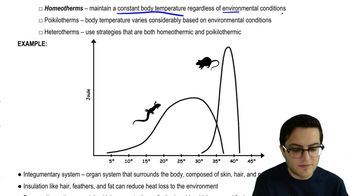
Endothermy refers to the ability of an organism to regulate its body temperature internally, allowing it to maintain a stable temperature regardless of external conditions. This metabolic process requires a significant amount of energy, which is derived from the food the animal consumes. Endothermic animals, such as mammals and birds, typically have higher metabolic rates compared to ectothermic animals, influencing their energy and waste production.
Recommended video:
Guided course
09:51
Thermoregulation

Nitrogenous Wastes

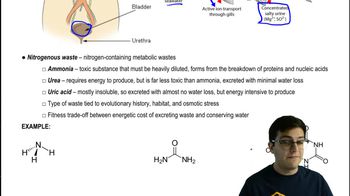
Nitrogenous wastes are byproducts of protein metabolism, primarily consisting of urea, uric acid, and ammonia. These wastes are produced when proteins and nucleic acids are broken down for energy or other metabolic processes. The amount and type of nitrogenous waste produced can vary significantly between carnivores and herbivores, with carnivores generally producing more due to their higher protein intake from animal tissues.
Recommended video:
Guided course
07:16
Osmoregulation and Nitrogenous Waste

Dietary Influence on Metabolism

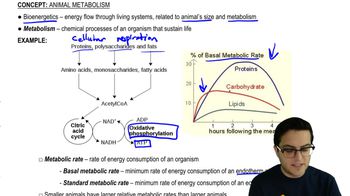
The diet of an animal significantly influences its metabolic processes and waste production. Carnivores typically consume high-protein diets, leading to increased protein catabolism and, consequently, higher nitrogenous waste output. In contrast, herbivores consume plant material, which is generally lower in protein and may result in lower nitrogenous waste production. This dietary difference is crucial for predicting the amount of nitrogenous waste produced by the two animals in the question.
Recommended video:
Guided course
07:08
Metabolic Rate