
Pearson+ LogoPearson+ Logo
Ch. 25 Control of Body Temperature and Water Balance
Taylor - Campbell Biology: Concepts & Connections 10th Edition
Taylor, Simon, Dickey, Hogan10th EditionCampbell Biology: Concepts & ConnectionsISBN: 9780136538783Not the one you use?Change textbook
Chapter 25, Problem 15

Which process in the nephron is least selective?
a. Secretion
b. Reabsorption
c. Filtration
d. Passive diffusion of salt

Verified step by step guidance
1
Understand the function of the nephron: The nephron is the functional unit of the kidney responsible for filtering blood and forming urine. It involves processes such as filtration, reabsorption, secretion, and passive diffusion.
Define filtration: Filtration occurs in the glomerulus, where blood plasma and small solutes are pushed through the filtration membrane into the Bowman's capsule. This process is driven by blood pressure and is non-selective, meaning it does not discriminate between useful substances and waste products.
Compare filtration to other processes: Secretion involves the active transport of specific substances (e.g., toxins, drugs) from the blood into the nephron. Reabsorption is highly selective, as it involves the active or passive transport of specific substances (e.g., glucose, water, ions) back into the blood. Passive diffusion of salt is selective based on concentration gradients and membrane permeability.
Identify the least selective process: Filtration is the least selective process because it allows all small molecules (both useful and waste) to pass through the filtration membrane indiscriminately, unlike secretion, reabsorption, or passive diffusion, which involve specific mechanisms or gradients.
Conclude the answer: Based on the definitions and comparisons, filtration is the least selective process in the nephron.

Verified video answer for a similar problem:

This video solution was recommended by our tutors as helpful for the problem above.
Video duration:
1m
Was this helpful?

Key Concepts

Here are the essential concepts you must grasp in order to answer the question correctly.

Nephron Function

The nephron is the functional unit of the kidney, responsible for filtering blood and forming urine. It consists of several parts, including the glomerulus, proximal tubule, loop of Henle, distal tubule, and collecting duct. Each part plays a specific role in the processes of filtration, reabsorption, and secretion, which are essential for maintaining fluid and electrolyte balance in the body.
Recommended video:
Guided course
06:04
Functional Groups

Filtration

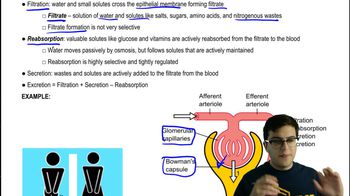
Filtration is the first step in urine formation, occurring in the glomerulus of the nephron. During this process, blood pressure forces water and small solutes, such as ions and glucose, through the glomerular membrane into the Bowman's capsule, forming the filtrate. This process is relatively non-selective, allowing a wide range of substances to pass while retaining larger molecules like proteins and blood cells.
Recommended video:
Guided course
04:03
Filtration, Reabsorption, and Excretion

Reabsorption vs. Secretion

Reabsorption and secretion are two key processes that occur after filtration. Reabsorption involves the selective uptake of water and solutes back into the bloodstream from the renal tubules, allowing the body to retain essential nutrients. In contrast, secretion is the active transport of substances from the blood into the tubular fluid, which helps eliminate waste products. While both processes are selective, filtration is the least selective, as it allows a broader range of substances to enter the nephron.
Recommended video:
Guided course
01:34
Protein Secretion
Related Practice
Textbook Question

A freshwater fish would be expected to

a. Pump salt out through its gills.

b. Produce copious quantities of dilute urine.

c. Have scales and a covering of mucus that reduce water loss to the environment.

d. Do all of the above.

1401
views
Textbook Question

Match each of the following components of blood (on the left) with what happens to it as the blood is processed by the kidney (on the right). Note that each lettered choice may be used more than once.


8. Water

9. Glucose

10. Plasma protein

11. Toxins or drugs

12. Red blood cell

13. Urea


a. passes into filtrate; almost all excreted in urine

b. remains in blood

c. passes into filtrate; mostly reabsorbed

d. secreted and excreted

1240
views
Textbook Question

You are in a room of empty chairs. As the chairs fill with people, you become hotter and hotter. A ceiling fan is turned on, and you feel cooler. You gained heat by _________ and lost heat to the environment by _________ .

a. Conduction … convection

b. Radiation … convection

c. Radiation … conduction

d. Convection … radiation

758
views
Textbook Question
Compare the water and salt regulation in a salmon when it swims in the ocean to when it migrates into fresh water to spawn.
1032
views
Textbook Question
Can ectotherms have stable body temperatures? Explain.
1293
views
Textbook Question
Two endothermic animals are the same size, but one is a carnivore and the other is an herbivore. Predict which of these animals would produce the greatest amount of nitrogenous wastes. Explain.
968
views