
Pearson+ LogoPearson+ Logo
Ch. 23 Circulation
Taylor - Campbell Biology: Concepts & Connections 10th Edition
Taylor, Simon, Dickey, Hogan10th EditionCampbell Biology: Concepts & ConnectionsISBN: 9780136538783Not the one you use?Change textbook
Chapter 23, Problem 2

Blood pressure is highest in _________ , and blood moves most slowly in _________ .
a. Veins; capillaries
b. Arteries; capillaries
c. Veins; arteries
d. Arteries; veins

Verified step by step guidance
1
Understand the structure of the circulatory system: Blood flows through arteries, capillaries, and veins in a closed loop. Arteries carry blood away from the heart, capillaries are the site of exchange between blood and tissues, and veins return blood to the heart.
Recall the relationship between blood pressure and blood vessel type: Blood pressure is highest in arteries because they are closest to the heart and receive blood directly from it. The pressure decreases as blood moves through the circulatory system.
Consider the speed of blood flow: Blood moves most slowly in capillaries because they have the smallest diameter and the largest total cross-sectional area, which allows for efficient exchange of gases, nutrients, and waste products.
Eliminate incorrect options: Veins do not have the highest blood pressure, and blood does not move most slowly in arteries or veins. This rules out options a, c, and d.
Select the correct answer: Based on the above reasoning, blood pressure is highest in arteries, and blood moves most slowly in capillaries. The correct answer is b.

Verified video answer for a similar problem:

This video solution was recommended by our tutors as helpful for the problem above.
Video duration:
1m
Was this helpful?

Key Concepts

Here are the essential concepts you must grasp in order to answer the question correctly.

Blood Pressure

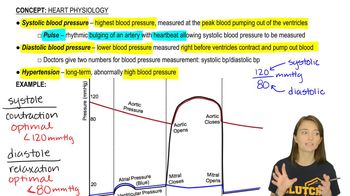
Blood pressure is the force exerted by circulating blood on the walls of blood vessels. It is highest in the arteries, particularly during systole when the heart contracts and pumps blood into the arterial system. Understanding blood pressure is crucial for comprehending how blood flows through the circulatory system and how it varies in different types of blood vessels.
Recommended video:
Guided course
15:53
Blood Pressure

Blood Vessels

Blood vessels are the conduits through which blood flows in the body, including arteries, veins, and capillaries. Arteries carry oxygen-rich blood away from the heart under high pressure, while veins return oxygen-poor blood back to the heart. Capillaries, the smallest blood vessels, facilitate the exchange of oxygen, carbon dioxide, nutrients, and waste between blood and tissues, which is why blood moves most slowly in them.
Recommended video:
Guided course
07:01
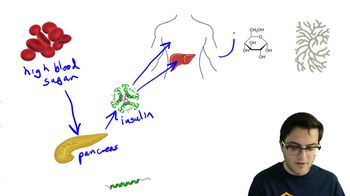
Blood Sugar Homeostasis

Circulatory System

The circulatory system is responsible for transporting blood, nutrients, gases, and waste products throughout the body. It consists of the heart, blood vessels, and blood. The system operates in a closed loop, with arteries carrying blood away from the heart and veins returning it, while capillaries serve as the site of exchange, highlighting the importance of understanding the flow dynamics in different vessel types.
Recommended video:
Guided course
02:15
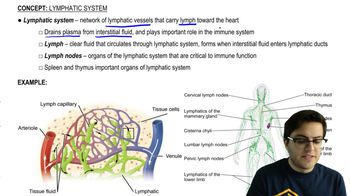
Lymphatic System
Related Practice
Textbook Question
Use the following diagram to review the flow of blood through a human cardiovascular system. Label the indicated parts, highlight the vessels that carry oxygen-rich blood, and then trace the flow of blood by numbering the circles from 1 to 10, starting with 1 in the right ventricle. (When two locations are equivalent in the pathway, such as right and left lung capillaries or capillaries of top and lower portion of the body, assign them the same number.)

3453
views
1
comments
Textbook Question

When the doctor listened to Janet's heart, he heard 'lub-hiss, lub-hiss' instead of the normal 'lub-dup' sounds. The hiss is most likely due to _________ . (Explain your answer.)

a. A defective atrioventricular (AV) valve

b. A damaged pacemaker (SA node)

c. A defective semilunar valve

d. High blood pressure

1020
views
Textbook Question

Which of the following is the main difference between your cardiovascular system and that of a fish?

a. Your heart has two chambers; a fish heart has four.

b. Your circulation has two circuits; fish circulation has one.

c. Your heart chambers are called atria and ventricles.

d. Yours is a closed system; the fish's is an open system.

1127
views
Textbook Question

Paul's blood pressure is 150/90. The 150 indicates _________ , and the 90 indicates _________ .

a. Pressure in the left ventricle; pressure in the right ventricle

b. Pressure during ventricular contraction; pressure during heart relaxation

c. Systemic circuit pressure; pulmonary circuit pressure

d. Pressure in the arteries; pressure in the veins

882
views