Pearson+ LogoPearson+ Logo
Ch. 23 Circulation
Taylor - Campbell Biology: Concepts & Connections 10th Edition
Taylor, Simon, Dickey, Hogan10th EditionCampbell Biology: Concepts & ConnectionsISBN: 9780136538783Not the one you use?Change textbook
Chapter 23, Problem 5

Paul's blood pressure is 150/90. The 150 indicates _________ , and the 90 indicates _________ .
a. Pressure in the left ventricle; pressure in the right ventricle
b. Pressure during ventricular contraction; pressure during heart relaxation
c. Systemic circuit pressure; pulmonary circuit pressure
d. Pressure in the arteries; pressure in the veins

Verified step by step guidance
1
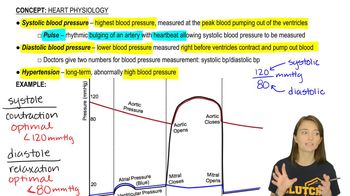
Understand the components of blood pressure: Blood pressure is typically expressed as two numbers, such as 150/90. The first number (150) is the systolic pressure, and the second number (90) is the diastolic pressure.
Define systolic pressure: Systolic pressure refers to the pressure in the arteries when the heart's ventricles contract and pump blood into the arteries. This is the higher number in the blood pressure reading.
Define diastolic pressure: Diastolic pressure refers to the pressure in the arteries when the heart is relaxed between beats. This is the lower number in the blood pressure reading.
Eliminate incorrect options: Review the provided choices and eliminate options that do not align with the definitions of systolic and diastolic pressure. For example, pressure in the left and right ventricles (option a) is not directly measured in a standard blood pressure reading.
Select the correct answer: Based on the definitions, the correct answer is the option that describes systolic pressure as pressure during ventricular contraction and diastolic pressure as pressure during heart relaxation (option b).

Verified video answer for a similar problem:

This video solution was recommended by our tutors as helpful for the problem above.
Video duration:
1m
Was this helpful?

Key Concepts

Here are the essential concepts you must grasp in order to answer the question correctly.

Systolic and Diastolic Blood Pressure

Blood pressure is expressed as two numbers: systolic and diastolic. The systolic pressure, the first number (150 in this case), measures the pressure in the arteries during ventricular contraction when the heart pumps blood. The diastolic pressure, the second number (90), measures the pressure in the arteries when the heart is at rest between beats, indicating the pressure during heart relaxation.
Recommended video:
Guided course
15:53
Blood Pressure

Ventricular Function

The heart has two ventricles: the left and right. The left ventricle pumps oxygenated blood into the systemic circulation, while the right ventricle pumps deoxygenated blood into the pulmonary circulation. Understanding the function of these ventricles is crucial for interpreting blood pressure readings, as they reflect the pressures generated during heart contractions and relaxations.
Recommended video:
Guided course
06:04
Functional Groups

Circulatory System Dynamics

The circulatory system consists of two main circuits: the systemic circuit, which delivers oxygenated blood to the body, and the pulmonary circuit, which carries deoxygenated blood to the lungs for oxygenation. Blood pressure readings are primarily associated with the systemic circuit, as they reflect the pressure exerted by blood in the arteries, which is critical for maintaining adequate blood flow and organ perfusion.
Recommended video:
Guided course
03:37
Disturbances Make Communities Dynamic
Related Practice
Textbook Question

Blood pressure is highest in _________ , and blood moves most slowly in _________ .

a. Veins; capillaries

b. Arteries; capillaries

c. Veins; arteries

d. Arteries; veins

1075
views
Textbook Question

When the doctor listened to Janet's heart, he heard 'lub-hiss, lub-hiss' instead of the normal 'lub-dup' sounds. The hiss is most likely due to _________ . (Explain your answer.)

a. A defective atrioventricular (AV) valve

b. A damaged pacemaker (SA node)

c. A defective semilunar valve

d. High blood pressure

1020
views
Textbook Question

Which of the following is the main difference between your cardiovascular system and that of a fish?

a. Your heart has two chambers; a fish heart has four.

b. Your circulation has two circuits; fish circulation has one.

c. Your heart chambers are called atria and ventricles.

d. Yours is a closed system; the fish's is an open system.

1127
views
Textbook Question

Which of the following initiates the process of blood clotting?

a. Damage to the lining of a blood vessel

b. Conversion of fibrinogen to fibrin

c. Attraction of white blood cells to a site of infection

d. Conversion of fibrin to fibrinogen

1229
views
Textbook Question

Blood flows more slowly in the arterioles than in the artery that supplies them because the arterioles

a. Have thoroughfare channels to venules that are often closed off, slowing the flow of blood.

b. Have sphincters that restrict flow to capillary beds.

c. Are narrower than the artery.

d. Collectively have a larger cross-sectional area than does the artery.

1204
views
Textbook Question

Which of the following is not a true statement about open and closed circulatory systems?

a. Both systems have some sort of a heart that pumps a circulatory fluid through the body.

b. A frog has an open circulatory system; other vertebrates have closed circulatory systems.

c. The blood and interstitial fluid are separate in a closed system but are indistinguishable in an open system.

d. Some of the circulation of blood in both systems results from body movements.

1673
views