Pearson+ LogoPearson+ Logo
Ch. 23 Circulation
Taylor - Campbell Biology: Concepts & Connections 10th Edition
Taylor, Simon, Dickey, Hogan10th EditionCampbell Biology: Concepts & ConnectionsISBN: 9780136538783Not the one you use?Change textbook
Chapter 23, Problem 17

Physiologists speculate about cardiovascular adaptations in dinosaurs—some of which had necks almost 10 m (33 feet) long. Such animals would have required a systolic pressure of nearly 760 mm Hg to pump blood to the brain when the head was fully raised. Some analyses suggest that dinosaurs' hearts were not powerful enough to generate such pressures, leading to the speculation that long-necked dinosaurs fed close to the ground rather than raising their heads to feed on high foliage. Scientists also debate whether dinosaurs had a 'reptile-like' or 'bird-like' heart. Most modern reptiles have a three-chambered heart with just one ventricle. Birds, which evolved from a lineage of dinosaurs, have a four-chambered heart. Some scientists believe that the circulatory needs of these long-necked dinosaurs provide evidence that dinosaurs must have had a four-chambered heart. Why might they conclude this?

Verified step by step guidance
1
Understand the cardiovascular requirements: Recognize that the long necks of certain dinosaurs would necessitate a high systolic blood pressure to pump blood from the heart to the brain when their heads were raised. This is due to the gravitational pull on the blood moving upwards against gravity over a long distance.
Compare heart structures: Know that most modern reptiles have a three-chambered heart with a single ventricle, which might not efficiently separate oxygenated and deoxygenated blood, potentially leading to less effective blood oxygenation and lower pressure outputs.
Consider the bird-like heart structure: Birds have a four-chambered heart, which allows for complete separation of oxygenated and deoxygenated blood, leading to more efficient pumping and higher pressure capabilities, which could be necessary to meet the physiological demands of long-necked dinosaurs.
Relate to evolutionary lineage: Since birds evolved from dinosaurs, the presence of a four-chambered heart in birds might suggest that their dinosaur ancestors, especially those with extreme physiological demands like long-necked species, could have developed a similar heart structure.
Evaluate physiological evidence: Conclude that the necessity for high blood pressure to reach elevated heads and the evolutionary relationship to birds provide strong evidence supporting the hypothesis that long-necked dinosaurs might have had a four-chambered heart to meet their circulatory needs.

Verified video answer for a similar problem:

This video solution was recommended by our tutors as helpful for the problem above.
Video duration:
2m
Was this helpful?

Key Concepts

Here are the essential concepts you must grasp in order to answer the question correctly.

Cardiovascular Adaptations

Cardiovascular adaptations refer to the physiological changes in the heart and blood vessels that enable an organism to meet its metabolic demands. In the context of dinosaurs, particularly long-necked species, these adaptations would be crucial for efficiently pumping blood over long distances, such as from the heart to the brain. Understanding these adaptations helps explain how dinosaurs could sustain their large body sizes and maintain proper blood flow.
Recommended video:
05:24
Adaptive Radiation

Heart Structure in Reptiles vs. Birds

The heart structure varies significantly between reptiles and birds, which is essential for understanding dinosaur physiology. Reptiles typically possess a three-chambered heart, which limits the separation of oxygenated and deoxygenated blood, while birds have a four-chambered heart that allows for complete separation and more efficient oxygenation. This difference is critical when considering the metabolic needs of large dinosaurs, suggesting that a more efficient heart structure may have been necessary for their survival.
Recommended video:
Guided course
07:36
Electrical Signals of the Heart

Systolic Blood Pressure

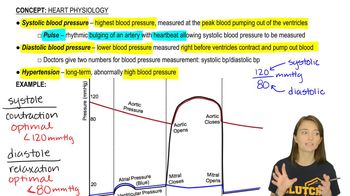
Systolic blood pressure is the pressure in the arteries during the contraction of the heart muscles, which is vital for understanding how blood is pumped throughout the body. For long-necked dinosaurs, a systolic pressure of nearly 760 mm Hg would be required to ensure adequate blood flow to the brain when the head is elevated. This high pressure raises questions about the capabilities of dinosaur hearts and supports the hypothesis that they may have needed a more advanced circulatory system, similar to that of modern birds.
Recommended video:
Guided course
15:53
Blood Pressure