Pearson+ LogoPearson+ Logo
Ch. 23 Circulation
Taylor - Campbell Biology: Concepts & Connections 10th Edition
Taylor, Simon, Dickey, Hogan10th EditionCampbell Biology: Concepts & ConnectionsISBN: 9780136538783Not the one you use?Change textbook
Chapter 23, Problem 14

Some babies are born with a small hole in the wall between the left and right ventricles. How might this affect the oxygen content of the blood pumped out of the heart into the systemic circuit?

Verified step by step guidance
1
Understand the normal function of the heart: The heart has four chambers - two atria and two ventricles. The right side of the heart receives oxygen-poor blood from the body and pumps it to the lungs, while the left side receives oxygen-rich blood from the lungs and pumps it to the rest of the body.
Identify the defect: A hole in the wall between the left and right ventricles is known as a ventricular septal defect (VSD). This hole allows blood to pass from the left ventricle to the right ventricle.
Analyze the consequences of the defect: Since the left ventricle contains oxygen-rich blood and the right ventricle contains oxygen-poor blood, the mixing of blood through the VSD can decrease the overall oxygen content of the blood that is pumped from the left ventricle into the systemic circuit.
Consider the impact on the body: The systemic circuit, which includes organs and tissues, may receive blood with lower oxygen levels than normal. This can lead to symptoms such as fatigue, shortness of breath, and delayed growth and development in children.
Explore potential treatments: Treatment options for a VSD can include monitoring the condition, medication to manage symptoms, or surgery to repair the defect, depending on its size and the severity of the symptoms.

Verified video answer for a similar problem:

This video solution was recommended by our tutors as helpful for the problem above.
Video duration:
42s
Was this helpful?

Key Concepts

Here are the essential concepts you must grasp in order to answer the question correctly.

Ventricular Septal Defect (VSD)

A Ventricular Septal Defect (VSD) is a congenital heart defect characterized by a hole in the septum that separates the left and right ventricles of the heart. This defect allows blood to flow abnormally between the two ventricles, which can lead to mixing of oxygenated and deoxygenated blood. Understanding VSD is crucial for analyzing its impact on blood oxygen levels in the systemic circulation.
Recommended video:

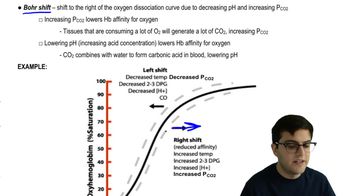
Oxygen Saturation

Oxygen saturation refers to the percentage of hemoglobin molecules in the blood that are bound to oxygen. In a healthy heart, oxygen-rich blood from the lungs is pumped into the systemic circuit, while deoxygenated blood returns to the lungs. A VSD can decrease the overall oxygen saturation of the blood pumped into the systemic circuit, as some oxygen-poor blood from the right ventricle may mix with oxygen-rich blood from the left ventricle.
Recommended video:
Guided course
10:50
Oxygen Dissociation Curve and the Bohr Shift

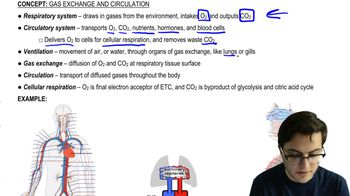
Systemic Circulation

Systemic circulation is the pathway through which oxygenated blood is distributed from the heart to the rest of the body and then returns deoxygenated blood back to the heart. The efficiency of this circulation is vital for delivering oxygen to tissues. A VSD can compromise this process by allowing deoxygenated blood to enter the systemic circulation, potentially leading to reduced oxygen delivery to body tissues and organs.
Recommended video:
Guided course
06:28
Gas Exchange and Circulation
Related Practice
Textbook Question
If a blood clot forms inside a vein in the leg, it may travel through the circulatory system. What is the first capillary bed the clot would reach, where it might block blood flow?
1200
views
Textbook Question
Explain how the structure of capillaries relates to their function of exchanging substances with the surrounding interstitial fluid. Describe how that exchange occurs.
1554
views
Textbook Question
Here is a blood sample that has been spun in a centrifuge. List, as completely as you can, the components you would find in the straw-colored fluid at the top of this tube and in the dense red portion at the bottom.

1798
views
Textbook Question
Juan has a disease in which damaged kidneys allow some of his normal plasma proteins to be removed from the blood. How might this condition affect the osmotic pressure of blood in capillaries, compared with that of the surrounding interstitial fluid? One of the symptoms of this kidney malfunction is an accumulation of excess interstitial fluid, which causes Juan's arms and legs to swell. Can you explain why this occurs?
828
views
Textbook Question

The studies described in Module 23.6 were funded by both government agencies and major pharmaceutical and medical supply companies. NIH grants for research on heart disease total more than \$1.2 billion per year. Gather more information and form an opinion on how heart disease research should be funded, whether by private enterprises such as pharmaceutical companies, donor-supported nonprofit organizations, or government agencies. Write an essay arguing your point of view.

777
views
Textbook Question
Physiologists speculate about cardiovascular adaptations in dinosaurs—some of which had necks almost 10 m (33 feet) long. Such animals would have required a systolic pressure of nearly 760 mm Hg to pump blood to the brain when the head was fully raised. Some analyses suggest that dinosaurs' hearts were not powerful enough to generate such pressures, leading to the speculation that long-necked dinosaurs fed close to the ground rather than raising their heads to feed on high foliage. Scientists also debate whether dinosaurs had a 'reptile-like' or 'bird-like' heart. Most modern reptiles have a three-chambered heart with just one ventricle. Birds, which evolved from a lineage of dinosaurs, have a four-chambered heart. Some scientists believe that the circulatory needs of these long-necked dinosaurs provide evidence that dinosaurs must have had a four-chambered heart. Why might they conclude this?
968
views