Pearson+ LogoPearson+ Logo
Ch. 12 DNA Technology and Genomics
Taylor - Campbell Biology: Concepts & Connections 10th Edition
Taylor, Simon, Dickey, Hogan10th EditionCampbell Biology: Concepts & ConnectionsISBN: 9780136538783Not the one you use?Change textbook
Chapter 12, Problem 10

A biologist isolated a gene from a human cell, inserted it into a plasmid, and inserted the plasmid into a bacterium. The bacterium made a new protein, but it was nothing like the protein normally produced in a human cell. Why? (Explain your answer.)
a. The bacterium had undergone transformation.
b. The gene did not have sticky ends.
c. The human gene contained introns.
d. The gene was not synthesized from scratch.

Verified step by step guidance
1
Understand the problem: The biologist inserted a human gene into a bacterial plasmid, and the bacterium produced a protein that was different from the one normally produced in human cells. The question asks why this happened, and we are given four possible explanations to evaluate.
Step 1: Recall the differences between eukaryotic and prokaryotic gene expression. In eukaryotes (like humans), genes often contain introns (non-coding regions) that are removed during RNA processing. Prokaryotes (like bacteria) lack the machinery to process introns, so they cannot correctly express genes that contain introns.
Step 2: Analyze the options: (a) Transformation refers to the uptake of foreign DNA by a bacterium, which did occur in this case, but it does not explain why the protein was different. (b) Sticky ends are important for inserting the gene into the plasmid, but if the gene was successfully inserted, this is not the issue. (c) If the human gene contained introns, the bacterium would not be able to process them, leading to an incorrect protein. (d) The gene not being synthesized from scratch is irrelevant to the problem.
Step 3: Focus on option (c): The presence of introns in the human gene is the most likely explanation. Since bacteria cannot process introns, the mRNA transcribed from the gene would include these non-coding regions, resulting in a faulty or incomplete protein.
Step 4: Conclude that the correct answer is (c), and explain that to express a human gene correctly in bacteria, scientists often use complementary DNA (cDNA), which is synthesized from processed mRNA and lacks introns.

Verified video answer for a similar problem:

This video solution was recommended by our tutors as helpful for the problem above.
Video duration:
1m
Was this helpful?

Key Concepts

Here are the essential concepts you must grasp in order to answer the question correctly.

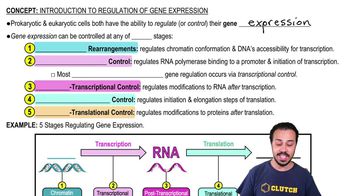
Gene Expression

Gene expression is the process by which information from a gene is used to synthesize a functional gene product, typically a protein. In eukaryotic cells, this involves transcription of DNA to mRNA, followed by translation of mRNA to protein. Bacteria, however, have different mechanisms for gene expression, which can lead to differences in the proteins produced when eukaryotic genes are expressed in prokaryotic systems.
Recommended video:
Guided course
06:40
Introduction to Regulation of Gene Expression

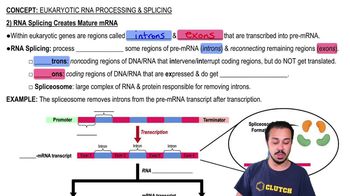
Introns and Exons

Introns are non-coding sequences within a gene that are transcribed into pre-mRNA but are removed during RNA splicing, leaving only exons, which code for proteins. Bacteria lack the machinery to splice introns out of eukaryotic pre-mRNA, meaning that if a human gene with introns is inserted into a bacterium, the bacterium may not produce the correct protein, as it cannot process the gene properly.
Recommended video:
Guided course
08:44
2) RNA Splicing Creates Mature mRNA

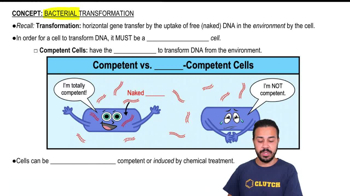
Transformation in Bacteria

Transformation is a process by which bacteria take up foreign DNA from their environment and incorporate it into their own genome. This allows for genetic modification and the expression of new traits. However, the success of transformation and the functionality of the expressed protein depend on the compatibility of the inserted gene with the bacterial cellular machinery, which can differ significantly from that of eukaryotic cells.
Recommended video:
Guided course
03:06
Bacterial Transformation
Related Practice
Textbook Question
Why does DNA profiling rely on comparing specific genetic markers rather than the entire genome?
1205
views
Textbook Question
Recombinant DNA techniques are used to custom-build bacteria for two main purposes: to obtain multiple copies of certain genes and to obtain useful proteins produced by certain genes. Give an example of each of these applications in medicine and agriculture.
1301
views
Textbook Question
A biochemist hopes to find a gene in human cells that codes for an important blood-clotting protein. She knows that the nucleotide sequence of a small part of the blood-clotting gene is CTGGACTGACA. Briefly outline a possible method she might use to isolate the desired gene.
785
views
Textbook Question

Explain how you might engineer E. coli to produce human growth hormone (HGH) using the following: E. coli containing a plasmid, DNA carrying the gene for HGH, DNA ligase, a restriction enzyme, equipment for manipulating and growing bacteria, a method for extracting and purifying the hormone, and an appropriate DNA probe. (Assume that the human HGH gene lacks introns.)

1768
views
Textbook Question
What is left for genetic researchers to do now that the Human Genome Project has determined nearly complete nucleotide sequences for all of the human chromosomes? Explain.
794
views
Textbook Question
Today, it is fairly easy to make transgenic plants and animals. What are some important safety and ethical issues raised by this use of recombinant DNA technology? What are some of the possible dangers of introducing genetically engineered organisms into the environment? What are some reasons for and against leaving decisions in these areas to scientists? To business owners and executives? What are some reasons for and against more public involvement? How might these decisions affect you? How do you think these decisions should be made?
1266
views