Pearson+ LogoPearson+ Logo
Ch. 12 DNA Technology and Genomics
Taylor - Campbell Biology: Concepts & Connections 10th Edition
Taylor, Simon, Dickey, Hogan10th EditionCampbell Biology: Concepts & ConnectionsISBN: 9780136538783Not the one you use?Change textbook
Chapter 12, Problem 8

Recombinant DNA techniques are used to custom-build bacteria for two main purposes: to obtain multiple copies of certain genes and to obtain useful proteins produced by certain genes. Give an example of each of these applications in medicine and agriculture.

Verified step by step guidance
1
Identify a gene of interest that is relevant to medicine, such as the insulin gene, which is crucial for treating diabetes. Explain how the gene can be isolated and inserted into a bacterial plasmid.
Discuss the process of transformation, where the recombinant plasmid is introduced into bacterial cells, allowing them to produce the protein encoded by the inserted gene, such as insulin.
Provide an example in agriculture, such as the gene for Bt toxin (from Bacillus thuringiensis), which is used to create genetically modified crops that are resistant to pests.
Explain how the Bt toxin gene can be inserted into the DNA of crop plants, and how this modification helps the plants to produce their own pest-resistant toxin, reducing the need for chemical pesticides.
Summarize the benefits of using recombinant DNA technology in both medicine and agriculture, highlighting how it allows for the production of beneficial proteins and enhances crop protection.

Verified video answer for a similar problem:

This video solution was recommended by our tutors as helpful for the problem above.
Video duration:
2m
Was this helpful?

Key Concepts

Here are the essential concepts you must grasp in order to answer the question correctly.

Recombinant DNA Technology

Recombinant DNA technology involves combining DNA from different sources to create new genetic combinations. This technique allows scientists to manipulate genes, enabling the production of specific proteins or the replication of desired genes. It is fundamental in genetic engineering, where organisms can be modified for various applications, including medicine and agriculture.
Recommended video:
Guided course
03:12
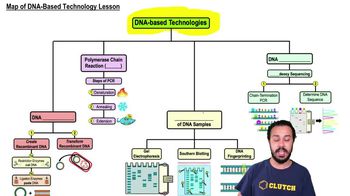
Map of DNA-Based Technology Lesson

Gene Cloning

Gene cloning is the process of making multiple copies of a specific gene. This is achieved by inserting the gene of interest into a vector, such as a plasmid, which is then introduced into a host organism, typically bacteria. The bacteria replicate, producing numerous copies of the gene, which can be used for research, therapeutic purposes, or agricultural improvements.
Recommended video:
Guided course
03:41
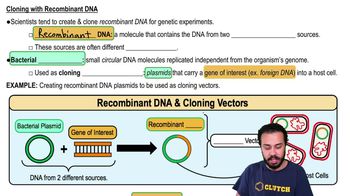
Cloning with Recombinant DNA

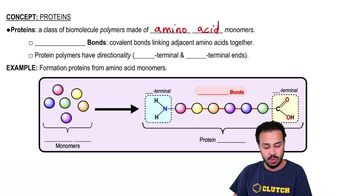
Protein Production

Protein production through recombinant DNA technology involves inserting genes that code for specific proteins into host organisms, allowing them to produce these proteins in large quantities. This application is crucial in medicine for producing insulin or monoclonal antibodies, and in agriculture for creating pest-resistant crops by producing proteins that deter pests or enhance growth.
Recommended video:
Related Practice
Textbook Question

How many genes are there in a human sperm cell?

a. 23

b. 46

c. About 21,000

d. about 3 billion

1793
views
Textbook Question

When a typical restriction enzyme cuts a DNA molecule, the cuts are uneven, giving the DNA fragments single-stranded ends. These ends are useful in recombinant DNA work because

a. They enable a cell to recognize fragments produced by the enzyme.

b. They serve as starting points for DNA replication.

c. The fragments will bond to other fragments with complementary ends.

d. They enable researchers to use the fragments as molecular probes.

1563
views
Textbook Question
Why does DNA profiling rely on comparing specific genetic markers rather than the entire genome?
1205
views
Textbook Question
A biochemist hopes to find a gene in human cells that codes for an important blood-clotting protein. She knows that the nucleotide sequence of a small part of the blood-clotting gene is CTGGACTGACA. Briefly outline a possible method she might use to isolate the desired gene.
785
views
Textbook Question

A biologist isolated a gene from a human cell, inserted it into a plasmid, and inserted the plasmid into a bacterium. The bacterium made a new protein, but it was nothing like the protein normally produced in a human cell. Why? (Explain your answer.)

a. The bacterium had undergone transformation.

b. The gene did not have sticky ends.

c. The human gene contained introns.

d. The gene was not synthesized from scratch.

1055
views
Textbook Question

Explain how you might engineer E. coli to produce human growth hormone (HGH) using the following: E. coli containing a plasmid, DNA carrying the gene for HGH, DNA ligase, a restriction enzyme, equipment for manipulating and growing bacteria, a method for extracting and purifying the hormone, and an appropriate DNA probe. (Assume that the human HGH gene lacks introns.)

1768
views